
Ukulele Lesson: Musetta from Puccini’s La Bohème
Giacomo Puccini’s La Bohème follows the intertwined lives of four young artists living in the Latin Quarter of Paris during the 1830s—Rodolfo the poet, Marcello the painter, Schaunard the musician, and Colline the philosopher. The opera paints a vivid picture of bohemian life: the joy of youthful friendship, the struggles of poverty, and the intensity of first love. At its heart is the romance between Rodolfo and the gentle seamstress Mimi, whose relationship unfolds with tenderness and tragedy.
Musetta enters the story in Act II and brings a burst of color and charisma to the opera. She is Marcello’s former lover—spirited, flirtatious, and accustomed to attention. Her famous waltz, “Quando m’en vo’,” is one of the signature moments of the opera. In this aria, she strolls through the busy Parisian café, deliberately turning heads as she sings about the power of her own charm. Though outwardly confident and glamorous, Musetta is also deeply human, and her rekindled affection for Marcello reveals a softer, more vulnerable side.
class=”p1″>The theme associated with Musetta—and sometimes connected to the tenderness between Mimi and Rodolfo—captures the elegance and emotional nuance so characteristic of Puccini’s writing. Its lyrical, lilting melody translates beautifully to the ukulele, making it a wonderful piece for players who want to explore expressive classical repertoire.</p>
Performance Notes
Before playing, study the chord shapes. In the opening measures, emphasize the 1st and 3rd beats, and play the
2nd beat softly, following the vocal line. Listening to vocal recordings will help you highlight the melody in your solo arrangement.
In measure 4, the grace notes on beat 3 use a hammer-on and pull-off. Measures 5 and 7 feature soft accompaniment. Begin measure 8 softly, building into the theme repeat at measure 9. Use rubato between measures 12 and 13, playing the chord at the end of measure 12 softly.
Measures 15 and 16 include Artificial Harmonics: hold the D chord shape, lightly touch the fret wire at the 14th fret with your right-hand index finger, and pluck with your thumb. Do the same for the note on the 3rd string. Use rubato phrasing to give a vocal quality to the 2nd theme at measure 17, then follow the D.C. al Fine to repeat from the beginning through measure 16.
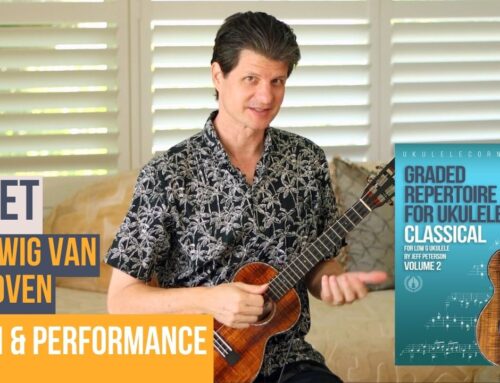
Graded Repertoire for Classical Ukulele: Volume 2
Musetta from Puccini’s La Bohème comes from our book Graded Repertoire for Classical Ukulele: Volume 2. The book has around 50 pieces of classical masterpieces carefully arranged for low-G ukulele in a progressive order. Starting with simple famous melodies like Bach’s Minuet in C, you progress step-by-step all the way through to classical favorites such as Fauré’s Pavane and Leyenda by Issac Albéniz.
Pick up your copy of Graded Repertoire for Classical Ukulele: Volume 2 here.
You can find lessons on these pieces and a whole library of different genres of music—including blues, Hawaiian, pop, classical, traditional, jazz, holiday, and more—at Ukulele Corner Academy. Learn more and join here.

Leave A Comment