
Por Ti Mi Corazón by Manuel M. Ponce: background and performance notes for classical guitar
Introduction
Por Ti Mi Corazón is one of Manuel María Ponce’s most intimate short works for guitar. Though modest in scale, it demanding in terms of tone control, pulse, and phrasing. The melody is song-like while the harmony is warm and often unsettled. While not technically demanding, it is quite a challenge to shape time and to allow the melody to sing. For that reason, it is a useful study in expressive playing.
For guitarists, the piece also sits within an important part of Ponce’s output. Ponce was one of the central figures in early twentieth-century Mexican art music, and his work often brought concert composition into contact with popular and folk materials. His long artistic relationship with Andrés Segovia was especially important for the guitar repertoire, and the group of Mexican popular-song arrangements associated with the mid-1920s remains a valued part of that legacy. Por Ti Mi Corazón is generally grouped with Tres Canciones Populares Mexicanas, alongside La Pajarera and La Valentina.
Background on the piece
Por Ti Mi Corazón was originally a vocal song with text by the poet Luis G. Urbina, first published in the early twentieth century and later adapted into Ponce’s guitar composition. By the late 1920s it was associated with the circle of Andrés Segovia, who published it alongside La Pajarera and La Valentina. Miguel Llobet also recorded it. The solo-guitar version preserves the character of an art song: a singing melodic line, expressive rubato, and accompaniment that supports the voice-like phrasing.
Tempo, pulse, and rubato
The first thing to settle is tempo. This is a very slow piece, around 40 beats per minute on the quarter note. But it should not feel mechanically slow. A strict pulse can make the line sound inert. Instead, play it with rubato, allowing the melody to expand and contract naturally. Nonetheless, the freedom with the pulse should still be controlled. The piece benefits from an inner pulse, and it helps to feel the beat in eighth notes rather than only in larger beats. That subdivision keeps the rhythm grounded while giving you room to stretch the line.
This is especially important in a piece where the melody repeatedly moves in and out of accompanimental textures. When the melodic line is exposed, let it sing with breath. When the music turns briefly toward accompaniment, keep it light. The last three notes of measure 3 are a good early example: keep them understated so the phrase does not become heavy before the next melodic idea begins.
Opening gestures and left-hand preparation
The short bursts of 32nd notes at the opening, and again in measures 4, 7, and 18, can appear more difficult on the page than they feel in the hand. Rather than trying to articulate every note with equal right-hand effort, use pull-offs to maintain legato. The goal is not brilliance for its own sake, but a quick, expressive flourish that grows naturally out of the melodic line.
Preparation in the left hand matters throughout the piece. In particular, set up the barre chord in measure 3 before you arrive there. At the end of measure 2, think ahead to the slide from the fourth to the seventh fret so the shift feels connected rather than abrupt. If the hand prepares early, the phrase can continue through the position change without sounding segmented. That kind of advance planning is essential in slow music, where every movement is exposed.
Voicing, chord treatment, and right-hand choices
Much of the interpretive work in Por Ti Mi Corazón comes down to voicing. The melody must remain clearly above the harmony, but not by force. In a slow lyrical piece, too much emphasis can make the line sound pressed. Aim instead for contrast of weight and color. Let the accompaniment support, not compete.
In measure 5, roll the long chords so they unfold rather than land all at once. That gives the sonority more breath and helps the music retain a vocal quality. For three-note chords that do not use the second string, using p-i-a can be an efficient and musical choice. It keeps the hand balanced and often gives a cleaner release than forcing a less natural fingering. In the faster melodic bursts, alternate index and middle fingers, and let slurs do part of the work whenever possible. The piece rewards efficiency: the more naturally the right hand moves, the easier it is to shape the phrase.
Dynamics and phrase endings
This piece needs a wide dynamic range, but the large gestures are often at the ends of phrases rather than in the middle. Each section should taper off at the ends of phrases noticeably. In particular, make the last two beats of measures 12 and 24 very soft, with a broad decrescendo leading into them. Those endings should feel like a release of tension.
The four-measure phrase beginning at measure 14 deserves special care. Because the harmonies shift more actively there, it can sustain a little more motion. Begin that phrase slightly faster, then slow down markedly in measure 17 so the return of the main theme feels prepared rather than sudden. This is one of the clearest structural moments in the piece. Shaping the rubato well here gives that melodic entrance more impact.
Listening and interpretive range
Por Ti Mi Corazón is a good reminder that expressive playing is not the same as sentimental excess. The score gives you room to push and pull the tempo, to vary tone color, and to use broad dynamics, but all of that has to remain tied to phrase structure. Listening to several recordings can be useful here, not so you can copy them, but so you can hear how different players handle space, chord rolls, and phrase endings. The range of convincing interpretations is fairly wide, which makes the piece especially valuable as a study in musical decision-making.
Conclusion
Though brief, Por Ti Mi Corazón demands a deep level of musicianship. It depends on careful subdivision, left-hand preparation, controlled rubato, and a strong sense of melodic hierarchy. While there are some technical demands, especially in the slurred flourishes and shifts, the larger challenge is to sustain a singing line while managing harmony and time with restraint. Played well, the piece can be a great lesson in how to make a phrase come to life.
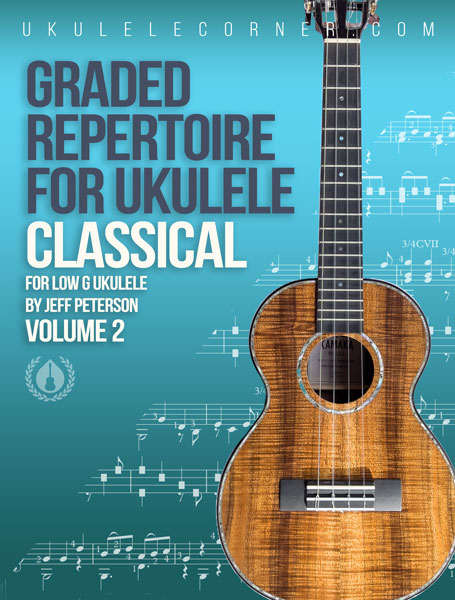
Graded Repertoire for Classical Ukulele: Volume 2
Por Ti Mi Corazón comes from our book Graded Repertoire for Classical Ukulele: Volume 2. The book has around 50 pieces of classical masterpieces carefully arranged for low-G ukulele in a progressive order. Starting with simple famous melodies like Bach’s Minuet in C, you progress step-by-step all the way through to classical favorites such as Fauré’s Pavane and Leyenda by Issac Albéniz.
Pick up your copy of Graded Repertoire for Classical Ukulele: Volume 2 here
Leave A Comment