
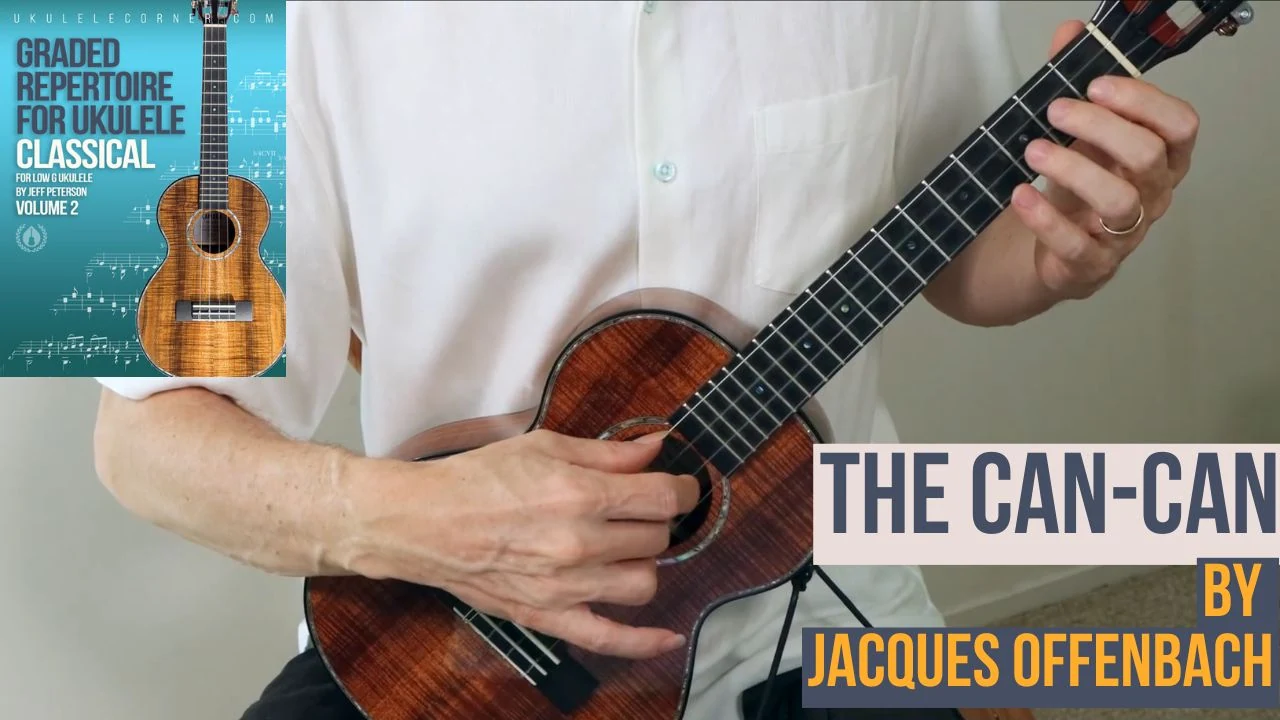
The Can-Can by Jacques Offenbach for Classical Ukulele
Introduction
The Can-Can is one of the most recognizable melodies in Western music. Even listeners who do not know its title usually recognize it once they hear it.
Jeff’s low-G ukulele arrangement focuses on right-hand alternation in first position while keeping the left hand challenges minimal. As you get comfortable with alternation you should also begin developing speed, as this piece benefits from a quicker tempo.
Because the piece moves through a complete octave of the C scale in first position, from the open third string to the third fret of the first string, it is a great way to connect scale practice with repertoire.
Jacques Offenbach and The Can-Can
Jacques Offenbach was a nineteenth-century composer best known for operetta, a theatrical form that combines spoken dialogue with light, fast-moving music. He built a career in Paris by writing witty, theatrical works. His music featured quick tempos and strong rhythmic character, and matched comic situations with sharp musical timing. Those qualities still come through in his most famous themes.
The melody known today as “The Can-Can” comes from the Galop Infernal in Offenbach’s operetta Orphée aux Enfers (Orpheus in the Underworld). In its original setting, the music belongs to a lively ensemble scene and carries the quick pulse and exaggerated spirit of stage comedy. Over time, that section escaped the operetta itself and took on a life of its own. It became closely associated with Parisian cabaret culture, especially the high-kicking dance style that later audiences linked with the Moulin Rouge.
That later cultural association is part of why the tune still works so well in arrangement. It is bright, rhythmic, and direct.
Performance Notes on the Ukulele Arrangement
This arrangement for low-G ukulele is in first position and outlines a full octave of the C scale. You begin on the open third string and work up to the third fret of the first string. Because the notes stay in this familiar area of the fingerboard, you can focus on coordination of the hands and building up your right-hand alternation.
In ukulele terminology, a position refers to where your first finger is placed. In first position, your first finger covers the first fret. Even when you are playing open strings, think of the hand as being rooted in first position.
The right hand matters just as much as the left. Alternate your right-hand fingers consistently. You may feel more comfortable starting with either the m finger or the i finger, but either one works well. Establish that alternation from the beginning at a slow tempo. You will need a right hand that is under your control so that the melody has a consistent pulse, even at faster tempos.
Aim for a tempo of around 140 beats per minute, but that is not where you should start. Build toward it gradually. Start at a speed where you are in full control of your alternation and you can maintain a clear rhythmic pulse. Then raise the tempo bit by bit. A metronome is useful here because it gives you an honest measure of progress and keeps the pulse steady as you push the speed higher.
Listen for evenness in tone between your i and m fingers. If one finger stands out more than the other, it can cause accents in the melody that disrupt the rhythmic flow of the line. The better you can control the evenness of your alternation, the more you’ll be able to keep the pulse steady across the whole phrase.
It also helps to keep the character of the music in mind. This is not just a scale exercise dressed up as a tune. The piece comes from the Galop Infernal, and its humor depends on brightness, momentum, and just a little bit of theatrical exaggeration. Picture cabaret dancers in Paris as you play. That image can help you keep the rhythm buoyant and the articulation lively.
While the main challenge, especially for beginner players, will be in the right hand, it’s important to take care of the left hand as well. Keep the left hand close to the fretboard and avoid excess motion.
Conclusion
The Can-Can is a fun piece for low-G classical ukulele because it combines familiarity, strong rhythm, and clear technical challenges. You get first-position scale work, right-hand alternation, and tempo building in a setting that is immediately recognizable and fun to play. Work patiently with the metronome and let the comic energy of Offenbach’s music come through.
Graded Repertoire for Classical Ukulele: Volume 2
The Can-Can by Offenbach comes from our book Graded Repertoire for Classical Ukulele: Volume 2. The book has around 50 pieces of classical masterpieces carefully arranged for low-G ukulele in a progressive order. Starting with simple famous melodies like Bach’s Minuet in C, you progress step-by-step all the way through to classical favorites such as Fauré’s Pavane and Leyenda by Issac Albéniz.
Pick up your copy of Graded Repertoire for Classical Ukulele: Volume 2 here
Comment puis-je acquérir le système utilisé pour tenir le ukulélé qu’utilise Jeff Peterson ?
Je suis opérée des 2 épaules et cela m’aiderait beaucoup.
Merci de me donner la procédure pour l’acheter et le prix.
Jeff utilise un support pour ukulélé fait maison. Vous pouvez trouver des supports similaires, comme le « A Frame Mini » de SageWorks. Une solution plus simple consiste à utiliser une sangle.