
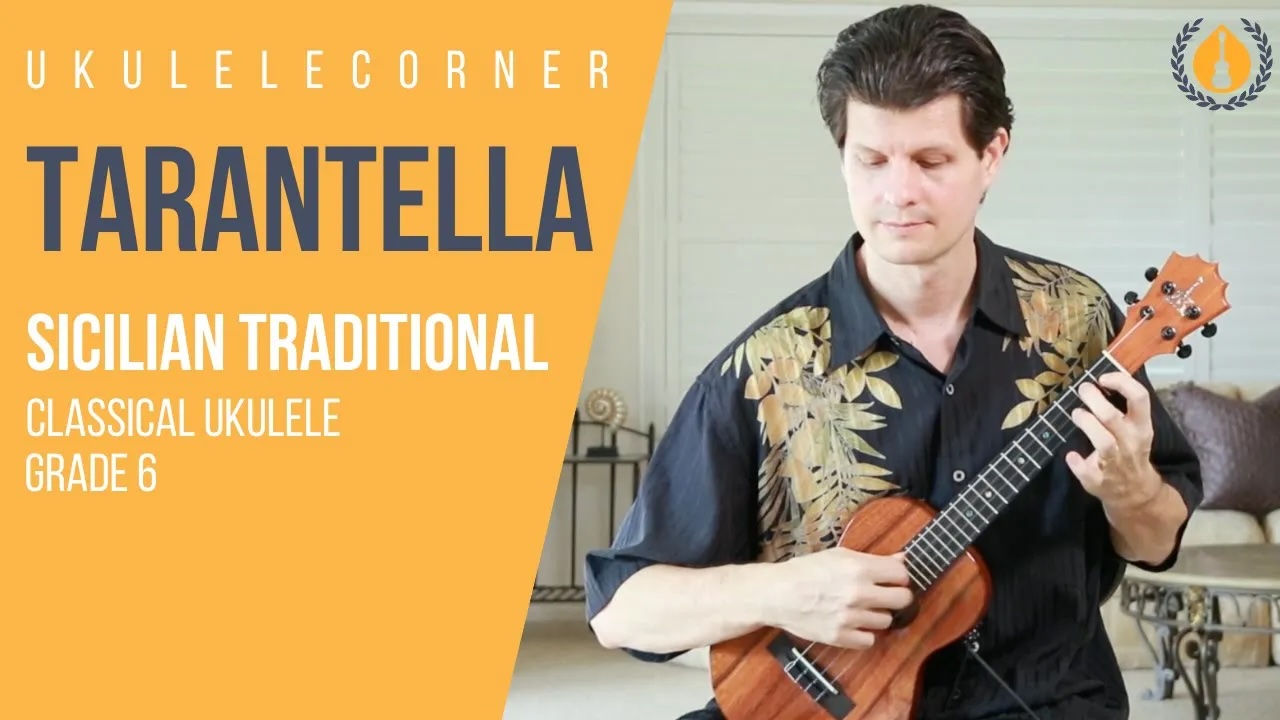
Tarantella for Ukulele
Long before it reached the concert hall, the tarantella was treated as medicine: people in southern Italy believed this fast dance could draw a spider’s venom out of the body. Below you’ll find the strange story behind the tarantella, followed by a guide to this fingerstyle arrangement.
You’ll find the sheet music for this Tarantella in Graded Repertoire for Ukulele: Classical, Volume 1. Get the book here.
A Dance Against the Venom
Spiders in Apulia
The tarantella comes from Apulia, the heel of the Italian boot. Both the dance and the tarantula spider take their names from Taranto, a port city in the region (the spider in question was a local wolf spider).
From the 15th through the 17th centuries, a condition called tarantism spread through Apulia. People who believed they had been bitten fell ill in different ways: some sank into a dazed melancholy, while others suffered cramps, convulsions, and nausea.
Dancing for Their Lives
The bite was thought to be deadly, and the accepted cure was music. Musicians played fast, driving tunes while the victim danced to sweat out the poison, sometimes for days on end; in their minds, they were dancing for their lives.
Modern understanding tells a different story. The spider’s bite is only mildly venomous, and most cases involved no bite at all. Historians now read tarantism as a community ritual, one that gave people a sanctioned way to release grief and distress through music and movement.
Over time, the tunes played for these healing dances became the music we call the tarantella. A local form of the dance survives in the Salento area of Apulia, where it is known as the pizzica.
From Folk Dance to Concert Hall
Many nineteenth-century composers wrote pieces in the style of the tarantella. Carl Maria von Weber closed his Piano Sonata No. 4 in E minor with a finale titled La Tarantella. Frédéric Chopin wrote his Tarantelle, Op. 43, in 1841 and asked a friend to consult Rossini’s tarantella songs to settle its time signature. Franz Liszt ended his Venezia e Napoli (published in 1861) with a furious Tarantella built on themes by Guillaume-Louis Cottrau.
Playing the Tarantella on Ukulele
The tarantella moves in a lively 6/8 time, so feel each measure as two big beats, each divided into three. Abrupt shifts between major and minor are a hallmark of the style, and this arrangement makes full use of them.
The piece is in D minor and opens with the same notes and fingering used for the D minor chord in Andantino by José Ferrer; if you have played that piece, this will be familiar.
The Slurred Sequence
The first section features a sequence of slurred notes moving over three harmonies: Gm, Dm, and A7. Practice it slowly at first, aiming for an even volume between the plucked notes and the slurred notes, and bring it up to tempo once the slurs sound smooth.
The Turn to D Major
The second section moves to D major (the parallel major key) and plays the same theme in this brighter key. The music stays in major up to the slurred section, where it slips seamlessly back into D minor. Isolate the measures where the key changes, and play them on their own until the shift feels natural.
Bringing the Dance to Life
Bring out the melody so it sounds clearly above the accompaniment. Sustain each bass note for the full measure by keeping your fretting fingers down, so the bass rings under the melody.
Use the two sections to create contrast: choose a different dynamic level and tone color for the D major section, then return to the original character when the minor key comes back. These contrasts give the piece its variety and drama.
Above all, remember that this music was born as a dance, and keep the 6/8 pulse steady and lively from start to finish.
Keep Exploring Classical Ukulele
Explore our free classical ukulele lessons, then browse our Top 10 Classical Pieces for Ukulele.
Graded Repertoire for Ukulele: Classical, Volume 1
Tarantella comes from our book Graded Repertoire for Ukulele: Classical, Volume 1. The book holds over sixty classical pieces arranged for Low G ukulele. They are ordered into eight grades of increasing difficulty. Early grades start with famous melodies like Beethoven’s Ode to Joy. Later grades build to favorites like Capricho Árabe by Tárrega.
Pick up your copy of Graded Repertoire for Ukulele: Classical, Volume 1 here