
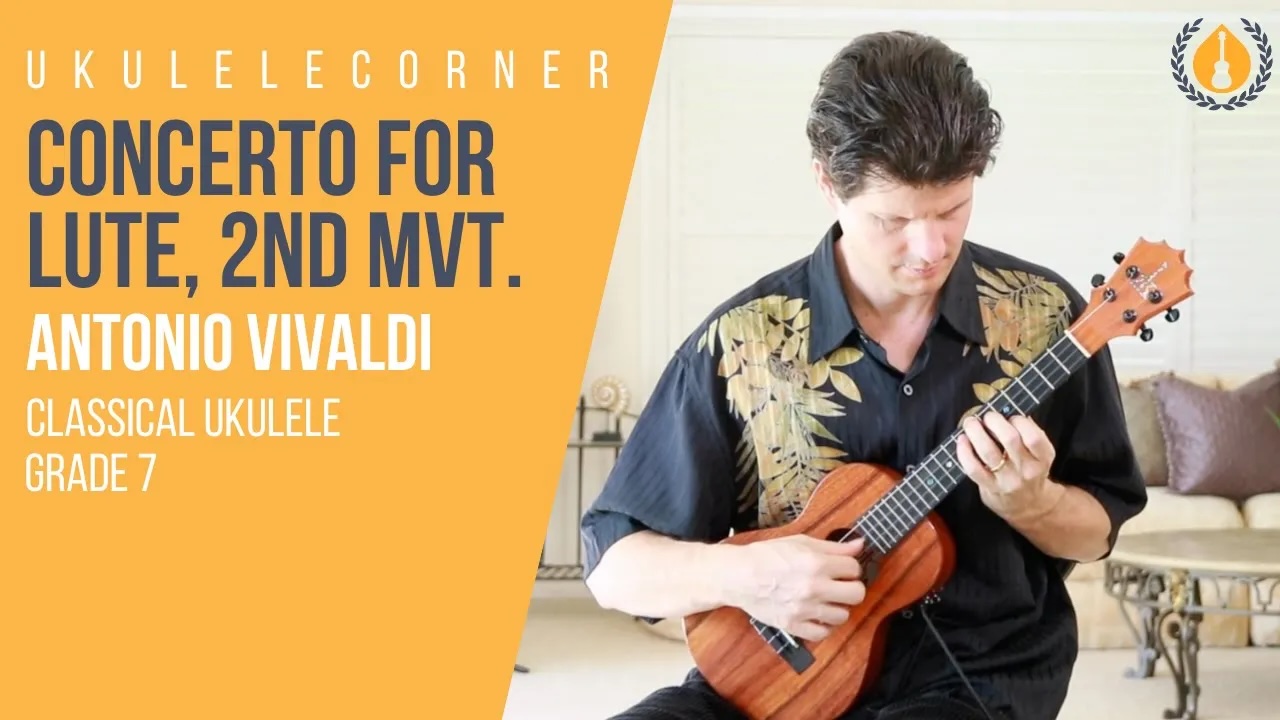
Vivaldi Largo for Ukulele: Concerto in D for Lute
Antonio Vivaldi wrote his Concerto in D for Lute for a Bohemian count during a journey north of the Alps, and its slow middle movement, the Largo, adapts beautifully to solo ukulele in the key of G. In this post you’ll read about Vivaldi and the story of the concerto, then work through the Largo’s rhythms and left-hand stretches.
The arrangement appears in our book Graded Repertoire for Ukulele: Classical, Volume 1, which you can order here.
Antonio Vivaldi, the Red-Headed Priest of Venice
Early Training
Antonio Vivaldi was an Italian composer and violinist who lived from 1678 to 1741. His father was also a musician and most likely gave Antonio his first musical training. Vivaldi began his professional life as a priest, which earned him the nickname il prete rosso, or “the red-headed priest.”
Teaching at the Ospedale della Pietà
In 1703, Vivaldi began teaching violin at the Ospedale della Pietà, an orphanage for girls in Venice. He composed many of his concertos and chamber works for the young musicians he taught there, and his work with the Pietà continued on and off until shortly before his death.
More Than 500 Concertos
A concerto features a solo instrument with orchestral accompaniment, and Vivaldi wrote over 500 of them alongside his choral music, opera, and church music. More than 800 of his works are known today, and only 135 of them were published during his lifetime. After his death his music was largely forgotten until much of it was rediscovered and published in the 20th century.
A Concerto Written in Bohemia
The Journey North
In 1729 and 1730, Vivaldi traveled north of the Alps with his father, Giovanni Battista Vivaldi. Part of that journey brought them to Bohemia, which is today part of the Czech Republic.
Count Wrtby
The Concerto in D for Lute is connected to a Bohemian nobleman, Count Johann Joseph von Wrtby (known in Czech as Jan Josef z Vrtba), who lived from 1669 to 1734. Two other Vivaldi works with lute share this link to the count, which scholars first recognized in the 1970s.
What the Manuscript Reveals
Vivaldi’s manuscript of the concerto survives in his personal music archive, now kept in Turin, Italy. Its paper type and the way its staff lines were drawn differ from the music paper Vivaldi used in Italy, and details like these help scholars trace the manuscript back to Bohemia.
Three Movements
The concerto pairs the solo lute with two violins and continuo across three movements: Allegro, Largo, and Allegro. The Largo is the slow middle movement, and its name is an Italian tempo marking that means “broad.”
Bringing the Largo to Ukulele
In this arrangement, a single ukulele carries both the melody and its supporting voices in the key of G. The slow tempo gives you room to let each note ring and to shape every phrase, which makes the Largo a good piece for practicing sustain and a relaxed left hand.
How to Play the Largo
Reading the Opening Rhythm
The piece opens with a dotted 16th note followed by a 32nd note. The figure may look intimidating on the page. But at this slow tempo it feels more like a dotted quarter note followed by an eighth note, which should make it more comfortable to play.
Sustain and Shifting Rhythms
Aim for as much sustain as possible in every voice by holding each note for its full value. Follow the rhythms carefully as well, since they shift between dotted and even patterns throughout the piece.
The Stretch in Measure 4
You can avoid the stretch in measure 4 by playing the note B on the 2nd string, 7th fret. This fingering replaces the B on the 1st string, 2nd fret, and it gives you more sustain.
To make it work, pivot with the left hand. Rotate your forearm forward to reach the high note with the 4th finger, then rotate back to play with the 1st finger while keeping the 2nd and 3rd fingers down.
Stretches in Measures 11 and 15
A few other stretches, like the one at the end of measure 15, become playable when you set up the left-hand 4th finger first and let the rest of the notes fall into place. For this stretch and the one in measure 11, bring the right side of your left hand very close to the fingerboard and keep the 4th finger very curved. In every one of these spots, the goal is a very relaxed left hand!
Putting It Together
Start by watching the performance video at the top of this page, listening closely to how long each note rings. Then isolate measures 4, 11, and 15, working each stretch slowly until it feels easy before you place it back into its full phrase.
More Vivaldi
Explore more of Vivaldi’s concerto music for ukulele in Jeff’s arrangement of Vivalid’s Andante from the Concerto for 2 Mandolins.
Keep Exploring Classical Ukulele
If you’d like to keep going, our guide to classical music on ukulele covers the wider repertoire, and our Top 10 Classical Pieces for Ukulele offers plenty of next steps.
Graded Repertoire for Ukulele: Classical, Volume 1
The Largo from Vivaldi’s Concerto in D for Lute comes from our book Graded Repertoire for Ukulele: Classical, Volume 1. The book holds over sixty classical pieces arranged for Low G ukulele. They are ordered into eight grades of increasing difficulty. Early grades start with famous melodies like Beethoven’s Ode to Joy. Later grades build to favorites like Capricho Árabe by Tárrega.
Pick up your copy of Graded Repertoire for Ukulele: Classical, Volume 1 here