
Brahms Lullaby for Ukulele
Brahms’ Lullaby is one of the most recognized melodies in the world. Parents have sung it to their babies for generations. In this post you’ll learn the story behind the piece and how to play it on ukulele.
This arrangement comes from our Graded Repertoire for Ukulele: Classical, Volume 1 book. Pick up your copy here.
Where the Melody Comes From
A Gift for a Friend
Brahms originally titled the piece “Wiegenlied: Guten Abend, gut’ Nacht.” In English, that means “Lullaby: Good evening, good night.” It is the fourth of Five Songs for voice and piano, published as Op. 49 in 1868.
Brahms wrote the song for his friend Bertha Faber. He composed it to celebrate the birth of her son in 1868. The published score carries a dedication to her, which is unusual within an opus of songs.
A Love Song Hidden Inside
Brahms and Bertha had known each other years earlier in Hamburg. She sang in a women’s choir he conducted there. The two used to sing an Austrian duet together called “S’Is Anderscht,” by Alexander Baumann.
Brahms built his lullaby to work as a harmony part to Baumann’s melody. He tucked Baumann’s tune into the piano accompaniment. So while the voice sings the lullaby, the piano quietly carries the old love song underneath.
Most later arrangements drop that counter-melody. What remains is the lullaby tune on its own, and that is the version most people know today.
The Words
The text of the first verse comes from Des Knaben Wunderhorn. This is a well-known set of German folk poetry and songs collected by Achim von Arnim and Clemens Brentano published some time between 1805 and 1808. Brahms returned to it often for his songs.
The lullaby was first performed in public in Vienna in December 1869, where Clara Schumann played the piano part.
About This Ukulele Arrangement
The piece is a gentle waltz in 3/4 time. This arrangement is in the key of C and only uses the top three strings of the ukulele.
The piece opens with a one-beat pickup (or anacrusis) of two eighth notes. Count “three-and” before the first full measure, then land on the downbeat.
The names of the chords implied by the notes are written above the standard notation staff. Start getting to know these chord names. You will see them often!
Playing Through the Piece
Let your right-hand thumb play all the notes on the 3rd string. Your index and middle fingers play the top two strings. This division will make things simpler for the right hand.
The form is pretty easy to follow, but may be new if you to you if you don’t yet know notation. At the end of measure 16, you reach the first ending. Repeat back to the first full measure. Play all the way through measure 15. Then jump to measure 17, the second ending, which is the last measure of the piece.
A Few Practice Notes
Watch the performance video at the top of this page before you start. Hearing the piece gives your ear a target for tempo and phrasing.
Practice the pickup into measure 1 on its own until it feels natural. Then work in short phrases. Walk through the repeat and the jump to the second ending so they are comfortable before you play at tempo.
Keep the dynamics soft and the rhythm steady. This is a lullaby, so let it rock gently.
Looking for More Classical Music for Ukulele?
Learn more about classical music on ukulele. Then explore our Top 10 Classical Pieces for Ukulele.
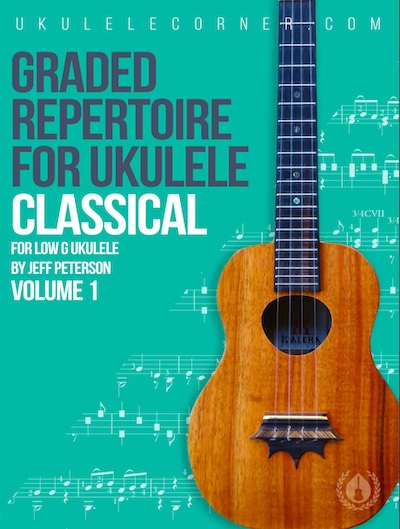
Graded Repertoire for Ukulele: Classical, Volume 1
Brahms’ Lullaby comes from our book Graded Repertoire for Ukulele: Classical, Volume 1. This book contains over sixty classical pieces arranged for Low G ukulele. The pieces are ordered into eight grades of increasing difficulty. You start with simple famous melodies like Beethoven’s Ode to Joy. You progress step by step to classical favorites such as Capricho Árabe by Tárrega.
Pick up your copy of Graded Repertoire for Ukulele: Classical, Volume 1 here



Leave A Comment