
Allegro by Giuliani – Classical Music Lesson for Fingerstyle Ukulele
Mauro Giuliani wrote hundreds of short études for guitar. Le Papillon, Op. 50 is one of his best loved collections, and the thirteenth piece in that set is a compact, driving Allegro in D minor. This lesson works through Jeff Peterson’s low-G arrangement for fingerstyle ukulele.
Except for its pace, Allegro looks simple at first. It’s just a steady stream of sixteenth notes from start to finish (musicians call this moto perpetuo, or “perpetual motion”). And the harmony is basically just three chords: D minor, G minor, and A or A7.
That simplicity is exactly what makes this such a valuable piece to learn. With so few moving parts, you can better hear and feel what each hand is doing. Ready to get started?
But, before we begin…get the free Study Guide
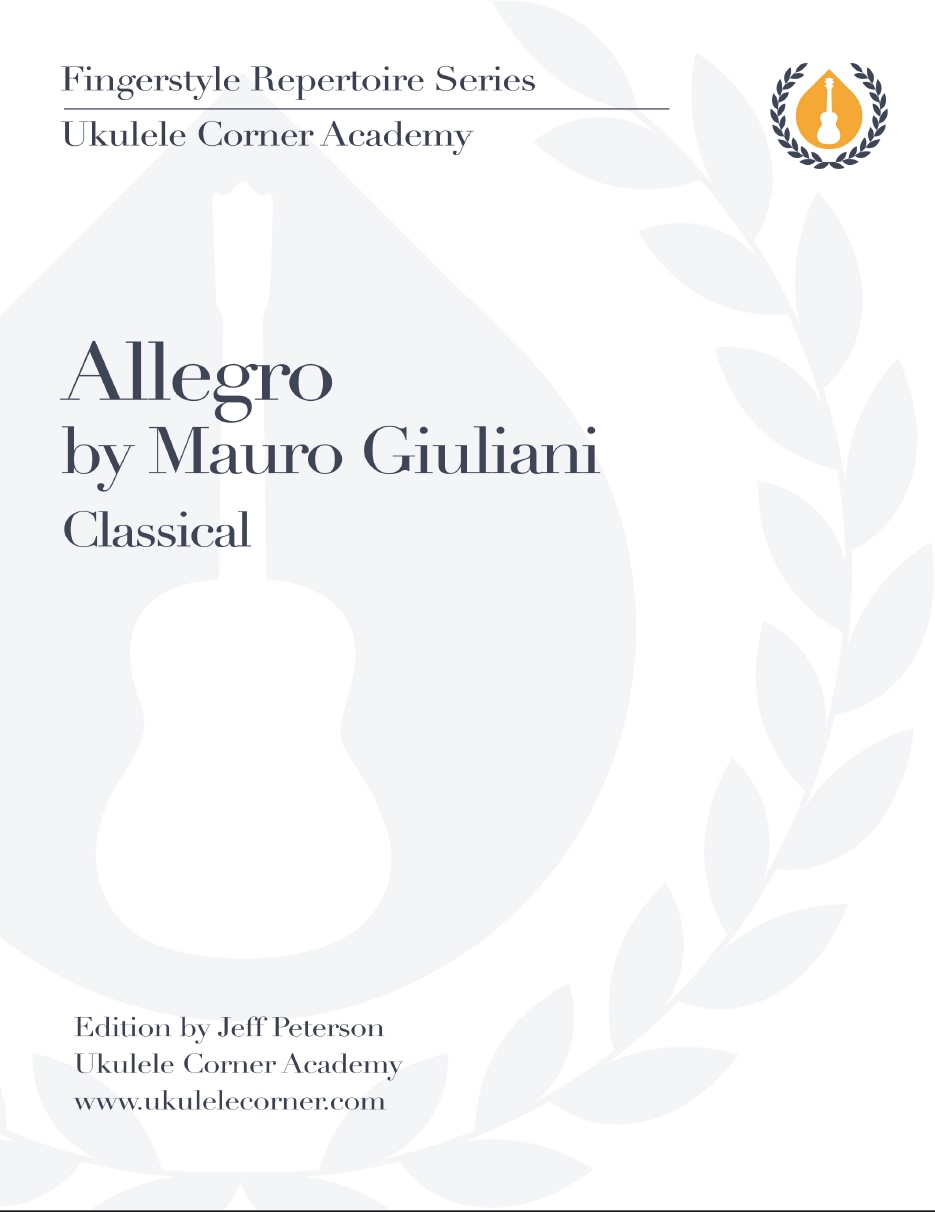
A free Allegro by Giuliani Study Guide covers all six steps, so you can work through them at your own pace. It includes the full score with TAB, plus written lesson notes on the harmony, bass line, arpeggio pattern, left-hand fingering, and phrasing. Download it and use it to follow along away from the video.
Who Was Mauro Giuliani?
Mauro Giuliani (1781 to 1829) was one of the most significant guitarist-composers of the early nineteenth century. He was born in southern Italy but built the bulk of his career in Vienna. There, he moved in the same musical circles as Beethoven and Rossini. He is said to have played cello at the 1813 premiere of Beethoven’s Seventh Symphony.
His works for guitar include the large-scale Rossiniana variations and several ambitious sonatas. These pieces helped establish the guitar as a serious concert instrument at a time when it was often dismissed as background music for the parlor.
But Giuliani clearly also cared a great deal about teaching. He wrote dozens of studies and progressive lessons for developing players. Collections like Le Papillon, Op. 50 (the source of this étude), were built to develop technique gradually. They use short, musical pieces rather than dry exercises.
Giuliani taught real musical ideas through manageable, well-sequenced repertoire. That’s exactly what makes his études such a natural fit for fingerstyle ukulele today.
Why you should learn this music
A few features make this a worthwhile piece to study.
Giuliani builds real musical interest into the thumb line by giving the melody to the bass, not the top voice. That means this music can help you develop bass control and melodic phrasing at the same time.
The harmony draws on the D harmonic minor scale, which is important to know for classical music. Listen for the C#: it gives the piece its distinctive color.
The right hand uses a P-I-M-A repeating sixteenth-note arpeggio pattern, which will help you build coordination you can use in countless other pieces.
The left hand benefits from unconventional fingering. A “pivot finger” approach helps anchor the third finger as you move from D minor to G minor. This simplifies things compared to the textbook fingering.
A six-part method for learning any piece
The video lesson above breaks the piece into six separate aspects. This is a study method you can use for anything you’re working on, not just this étude.
1. Harmony first
Before touching the piece itself, work through the D harmonic minor scale. Then cover the three underlying chords: i, iv, and V or V7. Once you can hear and finger those chords cleanly, the piece stops feeling like a string of unfamiliar shapes. It starts feeling like a short, logical chord progression.
2. Isolate the bass line
So much of the melody sits in the thumb. Practice the bass line completely on its own, including the muted rests. Giuliani writes deliberate silences into the bass part. Stop those notes with the right-hand thumb, rather than letting them ring out.
3. Build the right-hand pattern on open strings
Before adding the left hand, play the core PIMA arpeggio pattern on open strings. Then reintroduce the bass-muting technique once the pattern feels smooth. This isolates right-hand coordination from left-hand fingering, so you troubleshoot one variable at a time.
4. Find better left-hand fingerings
The conventional fingering for the G minor chord works fine on its own. But it creates an awkward jump when you move quickly between chords. An alternative fingering to that conventional shape keeps one finger anchored across the transition. It trades a slightly unusual chord shape for a smoother, faster result.
5. Guard against dropped notes
Fast, repetitive sixteenth-note patterns tend to lose their last note in each beat. Practice deliberately accenting that note: the “and” of beats two and four. Do this until it holds its own, instead of disappearing into the pattern.
6. Add dynamics and phrasing last
Once the technical elements are secure, the final layer is musical. Think swells, a build from mezzo-forte to forte, and a slight rallentando before the piece resolves. Ukulele has a narrower dynamic range than guitar or piano. Exaggerate these contrasts more than you might expect.
Try this approach on your own repertoire
This process works great for any piece you’re learning and can be broken into the same six questions:
- What’s the harmony?
- Where does the melody actually sit?
- What’s the core right-hand pattern?
- Is there a more efficient left-hand fingering?
- Which notes tend to get dropped?
- How do you want to shape this musically?
If you’re earlier in your fingerstyle journey, start with a broader foundation first. Try How to Learn Fingerstyle Ukulele, or work through the fundamentals in Fingerstyle Ukulele Technique: A Complete Guide.
Keep building your classical repertoire
Giuliani shows up more than once in the Ukulele Corner library. If you enjoyed this étude, Etude 20 by Giuliani for Classical Ukulele is a natural next stop, with its own set of right-hand and grace-note challenges.
If you want a fully structured path through classical, Hawaiian, blues, and folk fingerstyle repertoire, with every technique introduced in order rather than picked up piece by piece, that’s exactly what the Ukulele Corner Academy is built for.
Get the Free Study Guide
If you want to work through all six steps at your own pace, download the free Allegro by Giuliani Study Guide. It includes the full score with TAB plus written lesson notes covering the harmony, bass line, arpeggio pattern, left-hand fingering options, and phrasing suggestions from this lesson, so you can follow along away from the video.
Leave A Comment