
Andantino by José Ferrer on Baritone Ukulele
José Ferrer was an accomplished Spanish guitarist, composer, and educator who worked between Barcelona and Paris in the late nineteenth and early twentieth centuries. He taught at the Comédie Française in Paris and at the Conservatori Superior de Música del Liceu in Barcelona. While his writing is grounded in the tradition of the Spanish guitar, it also reflects that broader musical world of European theatrical and salon music.
This lesson will focus on bringing out both these characteristics: keeping the line singing while managing chord repetition, passing notes, grace-note figures, third intervals, and quick scale motion.
Start with the pulse and character
Before you worry about fingering details, it’s important to know the style. This piece is in A minor with a strong 6/8 feel. Remember that 6/8 has a slight accent on beats 1 and 4. The piece is in an Italianate style, which means it is lyrical, lightly dramatic, and always moving forward. Keep that character in mind to guide your phrasing throughout.
The beginning of the piece uses an unusual fingering. You need to use your pinky on the fifth fret of the fourth string so your other fingers can hold the inner strings on the fifth fret. This allows you to have enough curvature in the hand to let the high string ring open.
From there, move through the D minor and the thirds smoothly. When you shift up from the D minor shape and return, let your fingers travel in small, efficient motions. Don’t jump. Place each pair cleanly and shift directly to the next pair without extra tension or sliding loosely between them.
Ornamentation: small gestures, big effect
A major expressive feature of this piece is short ornaments throughout: hammer-ons, pull-offs, and grace notes that are quite quick. With each of these grace notes, the goal is a light, clean attack without a percussive accent.
Melody over accompaniment: shape the dynamic layers
Another important interpretive element of the music is balance in the voices. It can be easy to play the chords loudly, which can get in the way of the melody. Instead, we want the melody to be prominent, while the accompaniment is quieter.
To do so, play the inner chords softly while pushing into the strings more to let the top line come out.
Middle section details: controlled shifts and clean crossings
In the middle section of the piece, we have another grace note while holding on to a chord. Hold your A minor shape securely and practice the hammer-on to the pinky slowly until the target note rings clearly every time. Take it slowly and keep it controlled.
The following G7 to C motion and cross-string picking require right-hand planning. Avoid extra movement so the hand can feel stable. The right hand should feel calm even though the line is a bit more animated.
Harmonics: aim, contact, release
This piece features an artificial harmonic, which is almost like a little Olé! in the middle of this fun piece.
Artificial harmonics can provide a beautiful color to a note, but takes dedicated practice. While holding the fretted note with the left hand, use your right-hand index to touch the string directly above the fret wire. Then pluck the string with the thumb and release the index finger so the harmonic can ring clearly.
You can pluck the string with either the right-hand thumb or the ring finger. Experiment with both to see which one is easier for you.
Contrast
Later in the piece, the music opens up into a freer, quieter passage before returning to the main tempo. This contrast is central to the emotional arc of the music. Let it become intimate and conversational. Keep the bass sustained where indicated so the line feels grounded even as the upper line relaxes.
Then, when you return to the original tempo, bring back brightness and direction without becoming harsh.
D.C. al Fine
At the end of the piece you have the marking “D.C. al Fine,” which means to go back to the beginning of the piece and play up to the “Fine” where the piece ends. Try to create a different sound on the repeat, perhaps exploring different tone colors.
Final thoughts
This Andantino by Ferrer is a challenging but rewarding piece of music. I hope this lesson helps you craft a fun and successful musical interpretation.
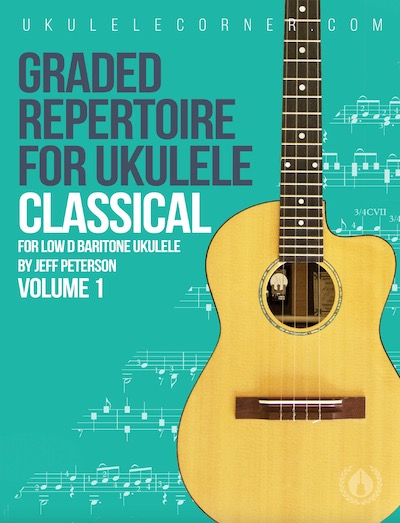
The Andantino by Ferrer comes from our book Graded Repertoire for Classical Ukulele: Baritone. This book contains over sixty classical pieces arranged for Baritone Low D ukulele. The book is carefully ordered into eight grades of increasing difficulty. Starting with simple famous melodies like Beethoven’s Ode to Joy you progress step-by-step all the way through to classical favorites such as Capricho Árabe by Tárrega and Jesu Joy of Man’s Desiring by J.S. Bach.
Purchase your copy of Graded Repertoire for Classical Ukulele: Baritone today.



Leave A Comment