
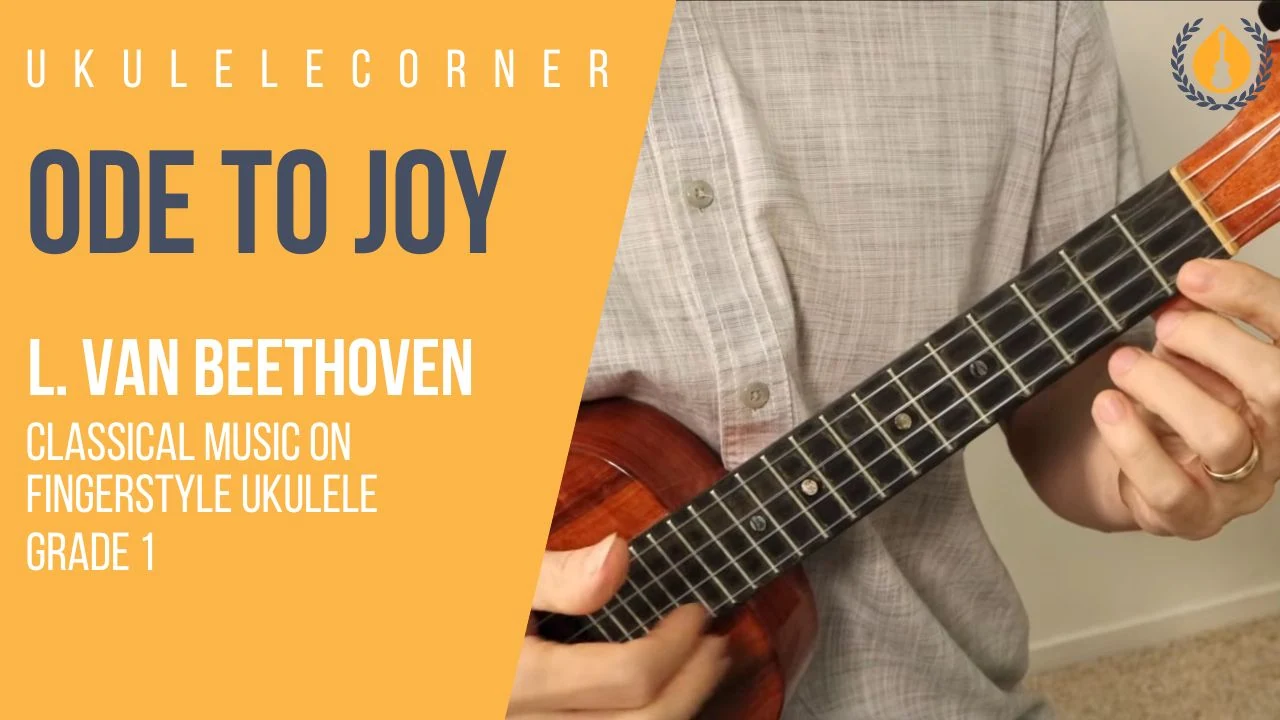
Ode to Joy for Ukulele
Beethoven’s Ode to Joy is one of the most celebrated musical themes in music history. You hear it in concert halls, in churches, and even at official ceremonies across Europe. It is also one of the best first pieces you can learn on the ukulele.
In this post we’ll tell you the story behind the melody and why it makes such a good starting point for fingerstyle ukulele.
Ode to Joy comes from our Graded Repertoire for Ukulele: Classical, Volume 1 book. Pick up your copy here.
Where the melody comes from
Schiller’s Poem
The words behind the melody come from the German poet Friedrich Schiller. He wrote An die Freude (To Joy) in 1785. The poem imagines all of humanity joined together across boundaries.
Beethoven read the poem as a young man and by 1793 he had resolved to set it to music someday. That plan took him more than thirty years to complete.
The Ninth Symphony
Beethoven composed his Ninth Symphony, his last, between 1822 and 1824. The Ode to Joy theme comes from the fourth movement, the finale. The orchestration includes a chorus, vocal soloists, and the full orchestra. Bringing singers into a symphony was a striking move at the time.
Beethoven set only about half of Schiller’s text. He also changed the order of the verses he kept.
For the melody itself, Beethoven drew on a humble model. He wrote it in the style of a social song, the kind of tune groups of friends sang together in Vienna.
A Premiere Beethoven Could Not Hear
The Ninth Symphony premiered in Vienna on May 7, 1824, at the Kärntnertor Theater. The same concert included three movements of Beethoven’s Missa solemnis and an overture. The musicians had only two rehearsals to prepare.
By this time Beethoven was profoundly deaf. Thus, Michael Umlauf conducted the performance while Beethoven sat among the orchestra with the score, marking the tempos. When the audience cheered, one of the musicians had to alert him to the applause.
How the melody became a symbol of freedom and hope
A Hymn Tune
In 1907, the American poet and minister Henry van Dyke wrote a new hymn text for Beethoven’s melody. He wrote it while serving as a guest preacher at Williams College in Massachusetts. The result was “Joyful, Joyful, We Adore Thee.” Hymnals often list the tune as “Hymn to Joy.”
The Anthem of Europe
In 1972, the Council of Europe adopted the Ode to Joy theme as its anthem. Later, in 1985, European Union leaders made it the official anthem of the EU. The anthem is performed without words, using only Beethoven’s music.
An Ode to Freedom
In December 1989, weeks after the Berlin Wall fell, Leonard Bernstein conducted the Ninth Symphony in Berlin. His orchestra and chorus brought together musicians from East and West Germany and also included players from the four nations that had shared control of the city. Bernstein changed a single word in the text. Freude (joy) became Freiheit (freedom).
Why you should learn Ode to Joy on ukulele
You already know how it goes
Most people can hum Ode to Joy before they can play it. That means you’ll hear right away when a note or rhythm slips. Learning to listen as you play is one of the most valuable habits you can build.
A true beginner piece
Ode to Joy uses only notes in first position on the top three strings and is in the key of F Major (which is an easy key for ukulele).
Moreover, because this is a melody, we can use it to focus on alternating our right-hand index and middle fingers. This alternation between i and m comes back again and again as you advance, so it’s a great technique to establish early on.
Finally, the rhythms are simple to understand. The piece is in 4/4 time. You’ll play quarter notes, half notes, and a few eighth notes. Watch the dotted quarter notes in measures 4, 8, and 16. Each one lasts a beat and a half and is followed by an eighth note.
You can play it on High-G, Low-G, and Baritone
The arrangement stays on the top three strings. High-G and low-G ukuleles share those three strings and differ only on the fourth. So you can play this arrangement in either tuning.
Baritone players can find Ode to Joy in our Graded Repertoire for Classical Ukulele – Low D Baritone book.
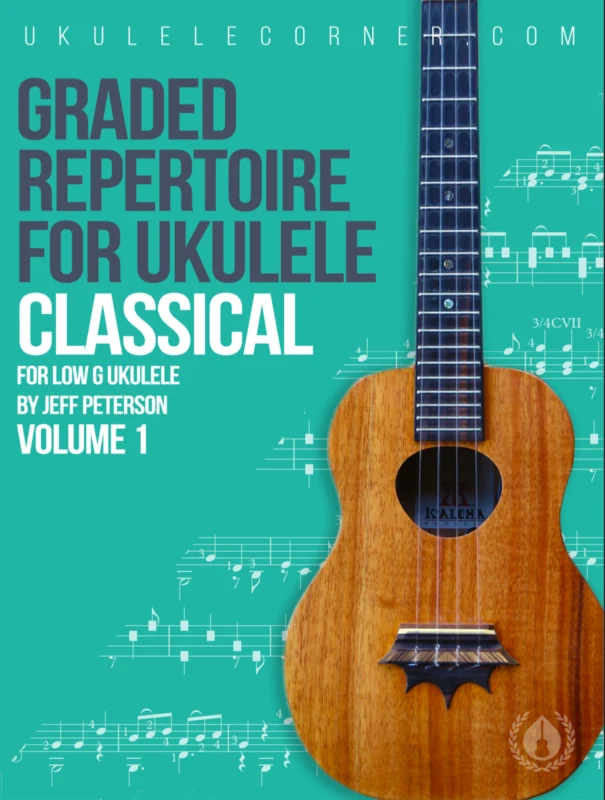
Graded Repertoire for Ukulele: Classical, Volume 1
Ode to Joy by Ludwig van Beethoven comes from our book Graded Repertoire for Ukulele: Classical, Volume 1. This book contains over sixty classical pieces arranged for low-G ukulele. It is ordered into eight grades of increasing difficulty. You begin with simple, famous melodies like Ode to Joy. From there you progress step by step to classical favorites such as Capricho Árabe by Tárrega.
Pick up your copy of Graded Repertoire for Ukulele: Classical, Volume 1 here
Looking for More Beethoven for Ukulele?
Once Ode to Joy feels comfortable, try Für Elise, Minuet in G, or the Moonlight Sonata. For a wider view, check out our Top 10 Classical Pieces for Ukulele and our guide to classical music on the ukulele.