
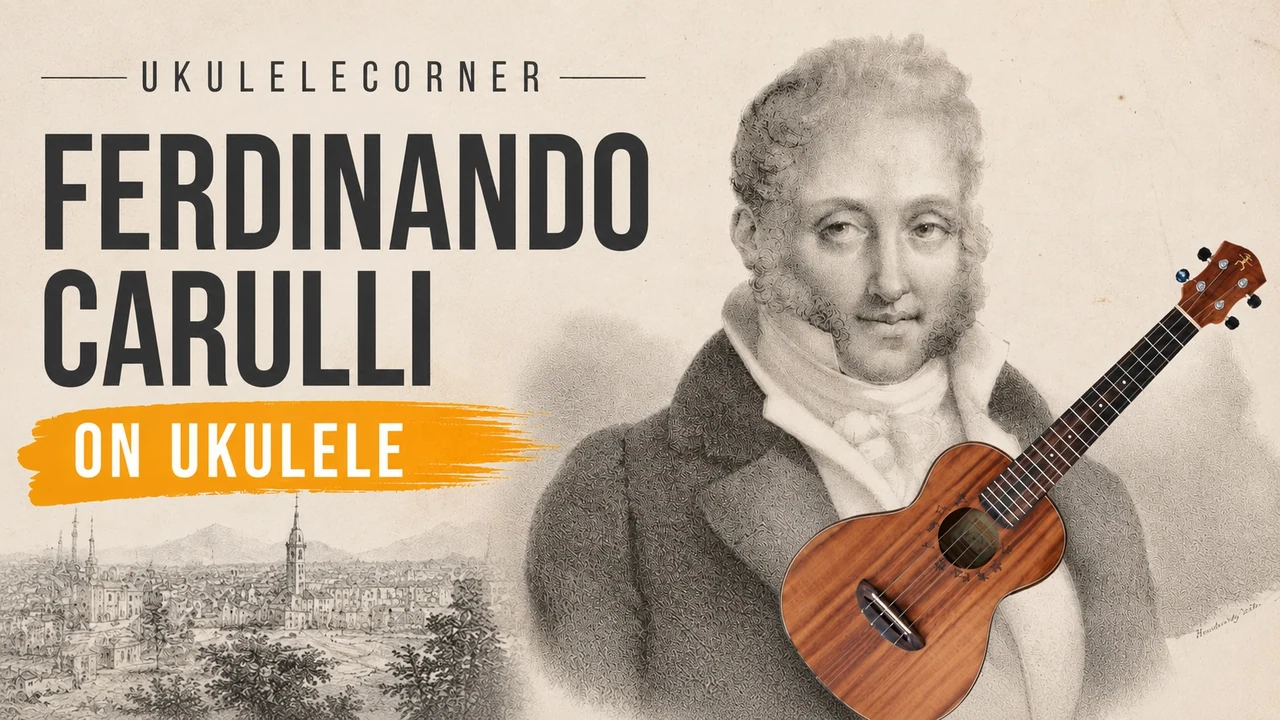
Ferdinando Carulli in the Early Grades
Ferdinando Carulli
Ferdinando Carulli (1770–1841) was an Italian guitarist, composer, and teacher. Born in Naples, he first played cello and did not discover the guitar until he was twenty years old. He eventually settled in Paris, where he became known especially as a teacher and wrote many pedagogical works for the guitar, including his important Méthode Complète, Op. 27, first published in 1810.
Carulli’s music is a natural fit for beginners on ukulele because so much of it was written with students in mind. Much of his music is collections of studies, many of them easy and progressive pieces for guitar. On ukulele, his pieces give you simple musical forms with achievable technical challenges, from arpeggiation in the Grade 1 Waltz to barre chords and 6/8 time in the Grade 3 Andante. So below we’ll look at five of his pieces that span Grades 1-3, which broadly represent the beginner stages of learning on ukulele.
Why the early grades matter
The early grades are where you build the habits that make the rest of the repertoire possible. In these stages you work on a clear tone, steady rhythm, simple musical forms, and left-hand movement without taking on music that is too difficult and can create unnecessary frustration.
That is the purpose of progressive repertoire. All of our graded repertoire books are ordered into eight grades of increasing difficulty, beginning with simpler pieces and moving step by step into more advanced works. They give you a clear path through the repertoire without putting up “walls of frustration” along the way.
Carulli’s music fits perfectly into that early path. His music is light and fun, rhythmic and charming, and has the right balance of comfort and challenge to keep you moving forward without feeling overwhelmed.
Begin with sound
Before looking at the pieces, take some time to focus on your sound. You can check out our technique tip video on how to get a nice sound on ukulele to get the fullness and richness your instrument can produce. The main idea is that the string should vibrate from floor to ceiling rather than in and out from the instrument. To do that we want to avoid pulling up on the string, but instead pushing down toward the soundhole with the finger. That helps create a warmer, fuller sound and allows you to play louder without the finger slapping against the frets.
Use the same approach when you work through these early Carulli pieces. Make contact with the string, apply pressure inward toward the soundhole, and release the finger back into the palm. Keep the contact point consistent so the sound stays consistent.
This focus on sound can really enrich these simpler pieces. When the notes are a bit easier, sound becomes even more important. Let the early grades help you listen more carefully to the tone you make.
Grade 1: Carulli’s Waltz
Carulli’s Waltz is a good introduction to playing notes across the strings with the thumb, index, and middle fingers of the right hand. This technique is called arpeggiation: you play the notes of a chord one at a time rather than all together.
Follow the right-hand fingering symbols carefully. In classical right-hand notation, p means thumb, i means index, and m means middle. You will also see a in other pieces, which means ring finger. These letters come from the Spanish terms pulgar, indice, medio, and annular.
In the A section, each finger has a clear role, so use the arpeggio pattern to move from one string to the next in a relaxed way.
The B section changes the texture. Instead of the arpeggio technique, use the thumb on the open fourth string, followed by index and middle playing together on the top two strings. This bass/chord/chord pattern is very common in 3/4 time, and it gives the waltz its accompaniment shape. (Think: “Boom-chuck-chuck.”)
Grade 2: Country Dance
Country Dance comes from Carulli’s 18 Morceaux faciles et progressifs, Op. 120 (18 easy and progressive pieces). It is the second piece in the collection and originally carries the title Contredanse. The arrangement has three brief sections in 2/4 time.
The first two sections use two-note chords with the open G on the fourth string played on the upbeats. Play those upbeat G notes softly so the emphasis stays on the higher chords on the downbeats.
In the second section, follow the dynamic markings closely. Measure 9 has a crescendo, and measures 11 and 12 have a decrescendo. Work for smooth and steady rises and falls in volume.
The third section moves from C major to A minor. It uses arpeggiation, bass-to-chord movement, and the open second string as a softer repeating tone beneath the melody. After the third section repeats, return to the beginning at the D.C. al Fine. Observe the repeats the first time through, then omit them during the D.C. al Fine section.
Grade 2: Etude No. 11
Etude No. 11 is in 6/8 time. There are six beats in each measure, with the eighth note receiving one count. To keep the emphasis clear, divide each measure into two groups of three: 1-2-3, 4-5-6. Place a slight emphasis on the 1st and 4th eighth notes.
After the opening eighth-note pickup beat (in classical music we call this an “anacrusis“), the rhythm is a quarter note followed by an eighth note. That pattern repeats in the second half of the first measure and continues into measure 2. Count it as 1 (2) 3, 4 (5) 6. The bass notes sustain for each group of three beats underneath that rhythm.
This gives the opening a lively, dance-like feel before the music moves into flowing eighth notes in measure 3 and continues into measure 4. Remember that in 6/8 time, the quarter note now receives two counts.
In the second half of the piece, the music moves into flowing eighth-note arpeggiation. Let the notes overlap so they form chords, and listen for the harmonic movement through G7, C, F, E7, Am, and Dm.
Grade 3: Andante
Andante is also in 6/8 time. It is in the key of B-flat (so be sure to take note of the B-flat and E-flat in the key signature!). The piece includes three-note block chords, shifts between two-note chords and bass notes, and several barre chords.
Pay close attention to the barre markings. CI indicates a full barre at the first fret. 1/2C covers the top two strings. 3/4C covers three of the four strings. Use only the number of strings necessary for each barre so the left hand does not use more energy than needed.
The piece is divided into three sections. Each section has first and second endings before the D.C. al Fine. The final note lands on beat 4 of measure 17. Hold that note and let it ring.
Andante appears in Grade 3 of Graded Repertoire for Classical Ukulele: Volume 2, after the Grade 2 Carulli pieces Country Dance and Etude No. 11.
Grade 3: Waltz in A
Carulli’s Waltz in A returns to the waltz style introduced in Grade 1, now in the key of A major. This low-G arrangement is transposed from the original key of E. A major has three sharps: F#, C#, and G#. Get comfortable finding these notes in first position, along with the accidental D# and A# notes that add tension and chromaticism to the music.
In the first section, measures 2 and 4 use repeated chords on each beat. Play the chords lightly on beats 2 and 3, and bring out the melody notes on beat 1.
The second section features a moving melody with repeated E notes on the upbeats on the second string. Play these open E notes softly, and bring out the downbeat melody notes with the right-hand thumb.
In measures 12 and 13, intervals of a tenth appear while the E note continues on the upbeats. Use the thumb and middle fingers to play the fourth and first strings, and use the index finger to play the second string lightly. This technique will appear again in Lágrima by Francisco Tárrega in Grade 6.
Measure 5 introduces a hinge barre. Practice the movement by repeatedly playing the C# on the third string with the open first string, then laying the first finger across the top three strings. The technique is called a hinge barre because the finger lays across the strings while keeping pressure down on the fingertip, like the hinge of a door.
This barre chord shape moves up one fret to second position in measure 6, then releases back to the original shape in measure 7. Practice the movement slowly so the barre lands cleanly and releases without extra tension.
A simple Carulli path
Ferdinando Carulli’s music is perfect for starting out on ukulele, especially if you are interested in classical music. His music is fun and charming but still presents technical challenges that will keep you growing on ukulele. These are not large concert works, but they are excellent pieces for developing a classical sound in a progressive way.