
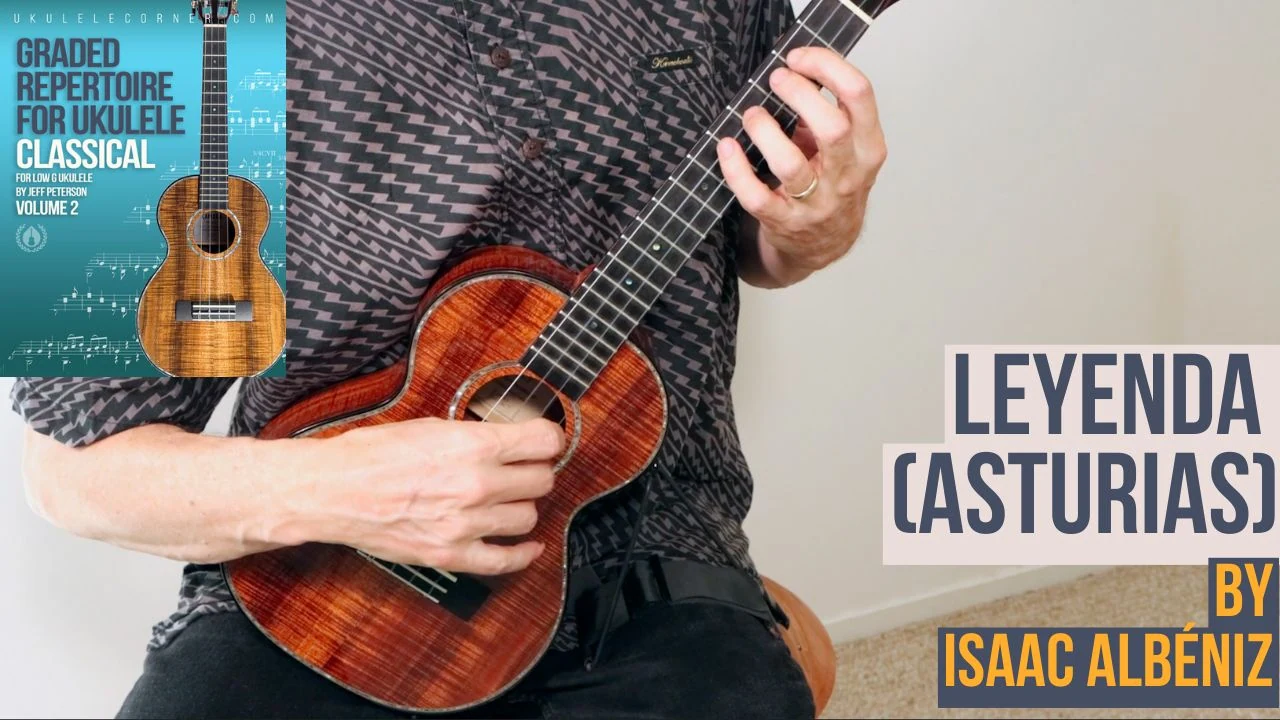
Leyenda by Albéniz for Classical Ukulele
Introduction
Isaac Albéniz’s Leyenda is also known by titles such as Prelude and Asturias and was first published as a prelude in Chants d’Espagne in 1892. The piece is strongly influenced by the flamenco traditions of Andalucia, Spain. It follows the bulería form and rhythm, and the arrangement brings that rhythmic drive to the ʻukulele in A minor.
Opening Pedal Tone and Right-Hand Pattern
In this version, the open 2nd string works as a pedal tone. It repeats between moving bass notes played with the right-hand thumb, creating the driving pattern that defines the opening section. The piece begins with 16th notes. Keep the repeated open 2nd string steady while the thumb plays the moving bass notes. The contrast between the pedal tone and the bass line gives the opening its rhythmic identity.
At measure 17, the rhythm shifts to 16th-note triplets. Add the high E with the 4th finger on the 1st string, and use a PIM arpeggio pattern. Let the notes ring together whenever possible.
Chords, Strums, and Left-Hand Control
From measure 25, use the index finger to strum the chords. Release the barre immediately to create a staccato effect. This section is demanding for the left hand, so give it focused attention. The challenge is not only forming the chord shapes, but releasing them quickly and cleanly.
At measure 33, the technique changes again. Move to the higher A minor chord shape with a 2-string barre, and play the tremolo with PIM.
Arpeggiation returns at measure 37 with new chord shapes. After the 4th-fret note, reset the left hand quickly. Measure 40 introduces a difficult reach before the chromatic chords. From there, the 2nd finger jumps across strings at the 4th fret, freeing the 4th finger to play the 5th fret. Continue using this approach through measure 58. The first section closes with the final E arpeggio line.
Middle Section and Flamenco Character
The middle section begins at measure 64 and should be played rubato. The harmonies and techniques in this passage draw on the flamenco cante jondo singing style, so allow more freedom in the timing.
Measures 80 through 84 should return to the first tempo. From there, push forward toward the bass run at measure 92.
Use pizzicato or palm muting in measures 107 and 109. This change in color helps separate the passage from the surrounding material. Build the arpeggiation at measure 111 before the octaves return.
Return and Coda
After the middle section, the first section repeats in its entirety. Keep the repeated material clear and rhythmically focused, especially after the freer middle section.
The coda begins at measure 122 and should feel more open and expressive. Let the section breathe, with space between sustained phrases and chords. At measure 131, play the muted theme slowly. Then build the final arpeggios with a rise and fall in both volume and tempo.
The harmonics and the final A minor chord should be nice and soft, and not feel rushed.
This is an advanced piece of music that will take time to build up, so be patient with it.
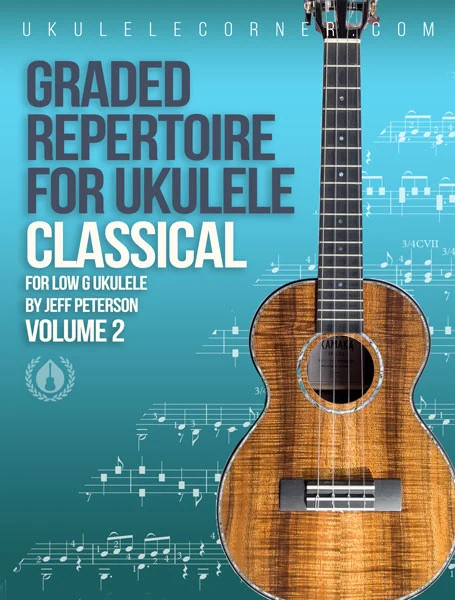
Graded Repertoire for Classical Ukulele: Volume 2
Leyenda by Albéniz comes from our book Graded Repertoire for Classical Ukulele: Volume 2. The book has around 50 pieces of classical masterpieces carefully arranged for low-G ukulele in a progressive order. Starting with simple famous melodies like Bach’s Minuet in C, you progress step-by-step all the way through to classical favorites such as Fauré’s Pavane.
Pick up your copy of Graded Repertoire for Classical Ukulele: Volume 2 here

Fantastic! Thanks!