
Jesu, Joy of Man’s Desiring for Ukulele
J.S. Bach’s Jesu, Joy of Man’s Desiring has become one of the most popular pieces of Western classical music. It shows up at weddings, in holiday programs, and in film scores. In this post we’ll look at its history and how it works on ukulele in Jeff Peterson’s arrangement.
Jeff’s arrangement of Jesu comes from our Graded Repertoire for Ukulele: Classical, Volume 1 book—pick up your copy here.
Where the Melody Comes From
A Cantata Repurposed for a Summer Feast
Bach first wrote this music in 1716 while he was working at the court in Weimar. That December, he was under pressure to produce new cantatas for three Advent Sundays in a row. The piece that became BWV 147 was written for the fourth of those Sundays, December 20.
Seven years later, Bach moved to Leipzig. He took a new position there as Thomaskantor. This job made him responsible for the music at the city’s four main churches. Leipzig kept its Advent Sundays free of elaborate music, so the piece Bach had written for Advent in Weimar had nowhere to go in his new post.
Bach reworked it for a different date instead, the Feast of the Visitation. The new version premiered in Leipzig on July 2, 1723. It became the seventh cantata of his very first year of church music there.
The Feast of the Visitation marks an event from the Gospel of Luke, celebrating Mary’s visit to her cousin Elizabeth. For this new version, Bach expanded the piece. The original six movements became ten. Each half of the cantata now ended with the same chorale setting.
That closing chorale did not exist in the earlier Weimar version. Bach composed it fresh for Leipzig.
The chorale text comes from a hymn called “Jesu, meiner Seelen Wonne” written by Martin Jahn in 1661. Bach set it to an older tune named “Werde munter, mein Gemüte,” by Johann Schop. Two different stanzas of that hymn close the two halves of the cantata. Movement 6 opens with the words “Wohl mir, dass ich Jesum habe.” Movement 10 opens with “Jesus bleibet meine Freude,” or “Jesus shall remain my joy.” This is the chorale that has come to be known as “Jesu, Joy of Man’s Desiring.”
Do you actually know the melody?
Here is a detail worth knowing if you already play this piece. The tune most people hum is not, strictly speaking, the hymn itself. Bach set the chorale as a plain, harmonized line for the choir. Then he doubled it with trumpet. Around that line, he wrapped a separate, flowing melody in the strings and oboe. And that flowing line is what has traveled into concert halls and piano transcriptions. The choir’s chorale line moves underneath it, more simply and more slowly.
The piece is in 9/8 time, so that every measure holds three groups of three eighth notes. Bach scholars often read that grouping of threes within threes as a nod to the Holy Trinity. This kind of musical symbolism shows up often in Bach’s church works, though the Trinity is never named directly in the text.
Bach’s Life in Cantatas
Supplying new music for church services was central to Bach’s job in Leipzig. Over his career there, he wrote roughly five annual cycles of cantatas. Each cycle covered the full church calendar, each holding somewhere around 60 cantatas. That makes his total output close to 300 sacred cantatas.
About a third of that number is now lost, leaving only around 200 cantatas that survive today.
This cantata belongs to Bach’s very first annual cycle in Leipzig. He wrote it in his first weeks in the city, in the summer of 1723. At this point in his career, he produced a new cantata almost every week in line with the demands of his job.
From Church Chorale to Concert Favorite
The chorale did not become famous through church performances alone. In the twentieth century, pianist Dame Myra Hess arranged the tenth movement for solo piano. She titled it “Jesu, Joy of Man’s Desiring.”
About This Ukulele Arrangement
The piece is written in 9/8 time, with each beat divided into a triplet. You should feel the rhythm like 3/4 time.
The arrangement uses campanella fingerings throughout. Campanella (which means bells) is a technique that lets fretted notes and open strings ring over each other. The result sounds close to a harp, or bells!
Most of the arrangement fits comfortably across four frets in the left hand. Two spots stretch further, to five frets. You will find them in measures 6 and 29. Take those measures slowly and let the stretch feel natural before moving on.
Playing Through the Piece
Start with a relaxed fourth finger and resist the urge to reach for the opening note. A subtle shift happens on beat five where your hand moves up one fret, into third position. Make this smooth so the listener barely notices the shift.
In measure 2, the index finger lays across the top two strings. This half barre sits at the third fret holding two notes down together. Your other fingers work the melody around it.
Measure 4 introduces slurs. A hammer-on connects beats four and five. A pull-off connects beats seven and eight. Both let two notes sound from a single pluck in the right hand. This gives the phrase a smoother, more vocal quality.
Measure 9 introduces two-note intervals. They add some building harmonic tension to the single melody line until he main theme returns at measure 17.
At measure 28, the harmony shifts, moving away from C major, into D minor and F major. A graceful transition follows and leads back to C major and the main theme at measure 40.
A Few Practice Notes
Watch the performance video at the top of this page before you start. Hearing the piece as a whole gives your ear a target. You will know how the phrasing and the ringing campanella should sound. Work through the piece in short sections, paying special attention to the stretches in measures 6 and 29. Then begin to piece these shorter ideas into phrases and eventually full sections before moving on to performance practice.
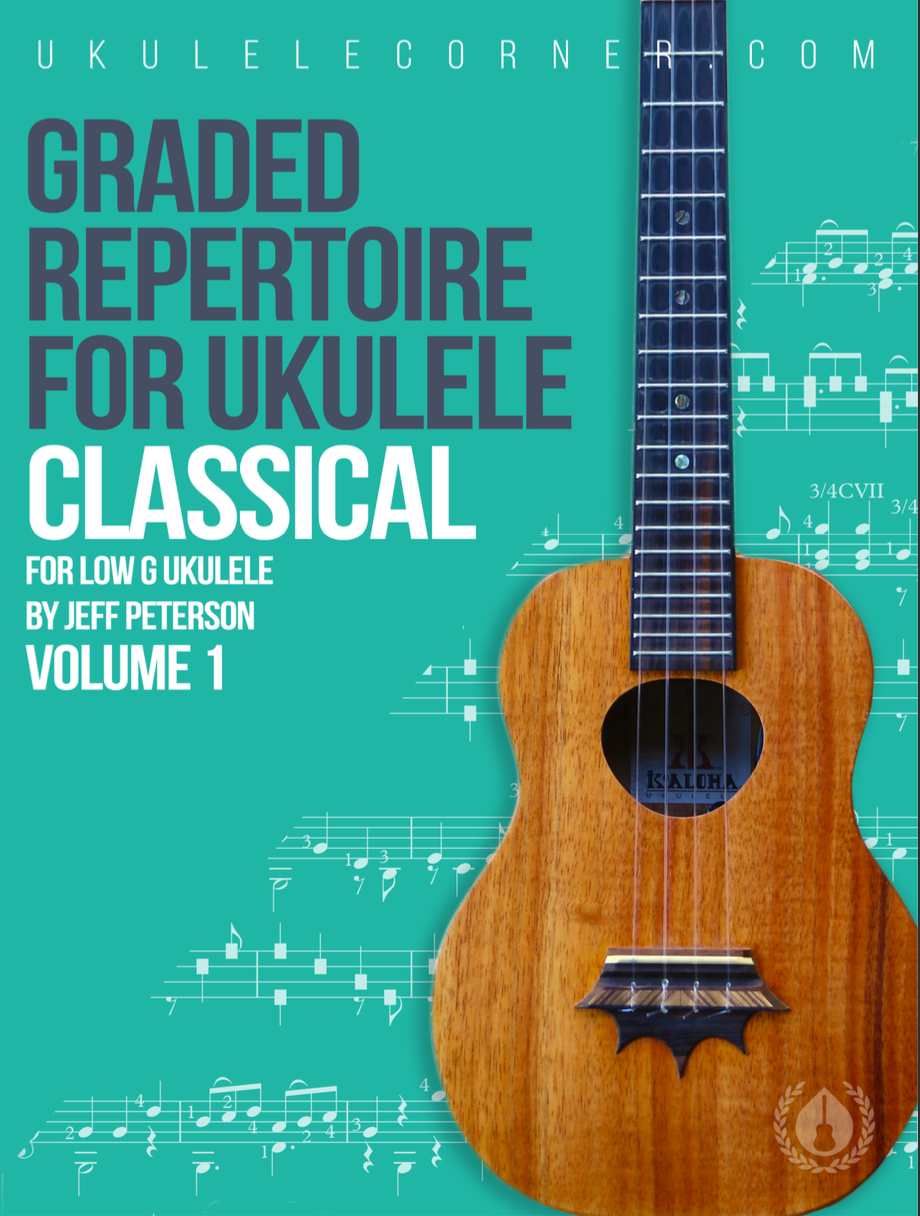
Graded Repertoire for Ukulele: Classical, Volume 1
Jesu, Joy of Man’s Desiring by J.S. Bach comes from our book Graded Repertoire for Ukulele: Classical Ukulele, Volume 1. This book contains over sixty classical pieces arranged for Low G ukulele. The book is carefully ordered into eight grades of increasing difficulty. Starting with simple famous melodies like Beethoven’s Ode to Joy you progress step-by-step all the way through to classical favorites such as Capricho Árabe by Tárrega
Pick up your copy of Graded Repertoire for Ukulele: Classical Volume 1 here
Looking for more Bach for Ukulele?
Check out our post on “J.S. Bach and…the Ukulele” to discover many other great pieces by Bach arranged for ukulele. If you just want to learn more about Classical music on ukulele, check out our Top 10 Classical Pieces for Ukulele.

Leave A Comment