

Renaissance Music for Ukulele: Nine Pieces to Explore
Renaissance music, written between roughly 1400 and 1600, was built on modes (the major and minor keys of later centuries were still developing at this time). Its main texture was polyphony, independent melodic lines woven together through imitation. Regional traditions colored this shared language differently: England leaned on popular tunes and lute ballads, Italy paired its court dances with detailed choreographic manuals, and Spain’s vihuela composers carried Moorish influence into their writing. The nine pieces below move through all three traditions.
Why Renaissance Music Suits the Ukulele
Much of this instrumental writing was for the lute, and it traveled easily to instruments sharing its plucking technique: the vihuela in Spain, and eventually keyboard instruments such as the virginal, which translated it onto keys. The ukulele belongs to that same lute family and shares its plucking technique directly, letting it play this repertoire close to its original form.
English Renaissance Music
England’s contribution to this era centers on the lute song and the popular tune, both carried by generations of lutenists and passed down through printed songbooks and manuscripts.
Come Again by Dowland
John Dowland wrote “Come Again” for his First Booke of Songes or Ayres in 1597. The piece is a lute song, originally meant for a singer accompanied by lute. The melody carries a bittersweet, longing quality typical of Dowland’s music, paired with cadences that dip into unexpected harmonic explorations.
On ukulele, the melody and the accompaniment merge into a single line. Listen for the sixteenth-note runs that decorate the ends of phrases and the closing figure that returns with small variations each time it appears. Take these runs at a tempo you can hold steady from the first appearance to the last, so a listener can hear the repeated figure as a deliberate variation.
Read the full lesson: Come Again by Dowland for Classical Ukulele
Come Again by Dowland comes from our book Graded Repertoire for Ukulele: Classical, Volume 2.
Alman by Robert Johnson
Robert Johnson was an English lutenist working in the same generation as Dowland. His “Alman” takes its name and its rhythmic character from a German dance form, the allemande. Dance pieces like this one carried a steady pulse meant to guide dancers through simple, repeated steps.
Thus, rhythmic clarity is key when we play this music on ukulele. Bass notes and melody notes often overlap on different strings, letting one voice ring while the other moves. Pay close attention to fingerings that let a note sustain across the bar line. This is what gives the piece its fuller, more resonant sound, and what connects it back to the ringing texture of the original lute writing.
Read the full lesson: Alman by Robert Johnson for Classical Ukulele
Alman by Robert Johnson comes from our book Graded Repertoire for Ukulele: Classical, Volume 2.
Kemp’s Jig
Kemp’s Jig commemorates a real historical event. It was composed around 1580 to celebrate an extraordinary feat by Will Kemp, an Elizabethan actor who danced eighty miles from London to Norwich over nine days. Kemp was a shareholder in the Lord Chamberlain’s Men alongside William Shakespeare, and many of Shakespeare’s comic roles are believed to have been written with Kemp’s particular style of physical comedy in mind.
The ukulele arrangement sits in the key of G, using second position with occasional shifts down to F chords in first position, a harmonic movement common across much of this repertoire. Keep the tempo spirited and imagine Kemp himself dancing along as you play. Articulate each eighth note clearly, alternating the index and middle fingers in the right hand. Watch for the half barre chord at measure 19, where a first-position F chord briefly flattens across the first two strings before resolving back to its original shape.
Kemp’s Jig comes from our book Graded Repertoire for Ukulele: Classical, Volume 1.
Greensleeves
Greensleeves is one of the best-known English melodies to survive from the Renaissance. Lute settings of the tune appear in several period sources, including the William Ballet Lute Book and a setting by Francis Cutting. Its minor-mode melody carries the same wistful character found across much of the era’s music for voice and lute.
The ukulele arrangement moves between a single melodic line and a fuller harmonized version built from three- and four-note chords, often rolled from low to high. Start with the melody alone to build familiarity with the shifts up and down the neck. Once the harmonized version feels comfortable, focus on keeping the left hand light through each chord change. The variety of historical settings for this one tune shows how much room Renaissance musicians found for reinterpretation, even within a single well-loved melody.
Read the full lesson: Greensleeves on Ukulele
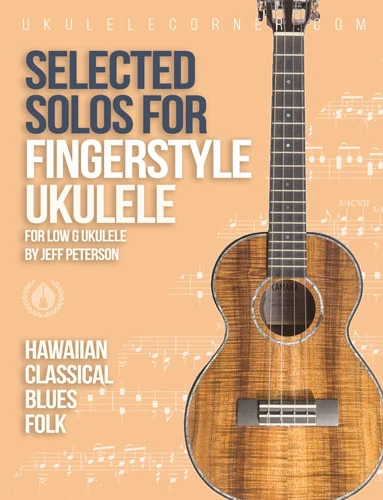
Greensleeves comes from our book Graded Repertoire for Ukulele: Classical, Volume 1 but it is also in our free book Selected Solos for Fingersytle Ukulele, which you can download here.
Italian Renaissance Dance
Italy’s court culture produced some of the era’s most enduring dance forms. Dance masters wrote and published detailed instructions alongside their music, giving us a rare window into how these pieces were actually used.
Bianco Fiore by Cesare Negri
Cesare Negri was an Italian dance master, choreographer, and composer. “Il Bianco Fiore,” meaning “White Flower,” comes from his 1602 collection Le Gratie d’Amore, a book of court dances complete with instructions and illustrations for the steps.
This piece began life as functional music, written to accompany dancers moving through a circle formation at court. That practical origin shows up in the steady, repeating structure of the piece. Play it with a clear, consistent pulse and let the repeated sections breathe as a dancer would. Bianco Fiore is a useful reminder that much of this repertoire was written to serve a physical, social purpose, not simply to be listened to.
Read the full lesson: Bianco Fiore by Cesare Negri for Classical Ukulele
Bianco Fiore by Negri comes from our book Graded Repertoire for Ukulele: Classical, Volume 2.
Italiana
Italiana takes its rhythmic character from the saltarello, a leaping dance form that dates back to fourteenth-century Tuscany. The name (saltarello) comes from a hop on the final upbeat of each phrase, and the piece keeps that same lively energy running through its triple meter.
The arrangement builds on a repeating ostinato bass pattern across the fourth, third, and second strings: a low G, a D, and a G an octave higher. Play the melody alone first to get comfortable with the eighth-note movement and the tied notes that appear partway through. Then bring in the bass pattern underneath. Combining the two parts takes patience, and the result is a satisfying introduction to counterpoint, one of the defining textures of Renaissance music.
Italiana comes from our book Graded Repertoire for Ukulele: Classical, Volume 1.
Spanish Vihuela Music
Spain’s Renaissance composers wrote primarily for the vihuela, a fretted instrument shaped like a guitar and tuned in a way that closely resembles the lute. Three pieces here come from this tradition.
Guárdame las Vacas by Narvaez
Luis de Narváez was one of the most important Spanish vihuela composers of the Renaissance, and “Guárdame las Vacas” is a set of diferencias, or variations, built over a well-known villancico melody rooted in the folk music of Spanish peasant farmers.
A repeating bass line anchors each variation while the upper voice grows more elaborate with every pass, a structure typical of Renaissance variation writing. The ukulele arrangement moves through F, C, D minor, and A harmonies in a flowing 6/4 meter. Alternate the index and middle fingers through the running eighth notes and let the thumb carry the bass. This combination keeps the variations steady and clear, even as the melody grows more ornamented.
Read the full lesson: Guardame las Vacas by Narvaez for Classical Ukulele
Guárdame las Vacas by Narvaez comes from our book Graded Repertoire for Ukulele: Classical, Volume 2.
Pavana 2 by Milan
Luis Milan published El Maestro in 1536, one of the earliest printed collections of vihuela music, and Pavana 2 is the second of six pavanas included in that collection. The pavana itself was a slow, stately processional dance performed by the aristocracy to open court ceremonies, and Milan’s writing captures that same measured grandeur.
The arrangement moves through block chords and flowing melodic lines built for a rich, sustained tone. Feel the 4/4 meter as two broad beats per measure to keep the tempo steady and unhurried.
Read the full lesson: Pavana 2 by Milan for Classical Ukulele
Pavana 2 by Milan comes from our book Graded Repertoire for Ukulele: Classical, Volume 2.
Pavana 1 by Luis Milan
Pavana 1 also comes from the same set of six vihuela pavanas from Milan’s El Maestro. The pavana form imitates the slow, stately walk of a peacock, or pavón, and this setting moves through lovely block chords, melodic runs, and overlapping phrases.
The piece sits mostly in D minor, resolving to D major at the close of its sections. That shift from a minor key to its parallel major at a cadence is known as a Picardy third, and it appears throughout Renaissance music as a way of closing a piece on a brighter, more settled chord. Use your left hand fourth finger as a guide into the sixteenth-note run at measure 18, and let a pull-off set up the notes that follow. Alternate the index and middle fingers in the right hand as the passage moves down through the strings.
Pavana 1 by Milan comes from our book Graded Repertoire for Ukulele: Classical, Volume 1.
More Renaissance Repertoire to Explore
These nine pieces are only a starting point. Renaissance music runs throughout the Graded Repertoire for Ukulele: Classical series of books, alongside music from the Baroque, Classical, Romantic, and modern eras.
- Graded Repertoire for Classical Ukulele, Volume 1
- Graded Repertoire for Classical Ukulele, Volume 2
- Graded Repertoire for Classical Ukulele, Volume 3
Want to play all this wonderful Renaissance music and more on your ukulele? Join Ukulele Corner Academy for a diverse curriculum of music for fingerstyle ukulele.
Of the 9 Renaissance tunes referenced, only 3 can be found in your Classical Graded Repertoire books. Is there any plans to offer the Renaissance tunes together in a book or download form?
Is there any issue, other than a different key, with the low G tabs in the Classical books being played with a low D Baritone tuning?
Hi Dave,
All nine pieces and others by Downland and Gaspar Sanz can be found in the 3 volumes of classical repertoire. All the pieces can be played on the low D baritone.
Hi Jeff!
Thank you for this very interesting post.
I really do love the music from this time period, and will listen my way through them then start divind in!
peace,
Dina K