
La Paloma for Classical Ukulele
La Paloma, which means “The Dove,” is the best-known work by Sebastián Yradier. Written in 1860 in the Basque countryside of Spain, it has remained in circulation for well over a century and continues to appear in many instrumental and vocal settings. This arrangement brings the piece to low-G ukulele in D and preserves its clear melody along with its characteristic rhythmic contrasts and ornamental writing.
Performance Notes
The introduction centers on a dotted eighth-note rhythm. That rhythm contrasts with the triplet rhythm of the melody. Practice counting each rhythm separately with a metronome and then alternating between them while maintaining one clear pulse so you can keep those rhythms accurate.
The melody begins in measure 2 with a slide from F-sharp to A on the second string. Use your pinky for the slide so your hand moves into second position. Throughout this section, the first finger often shifts between the third and fourth strings to sustain the bass line. Let notes ring where possible, and move quickly between strings.
In measure 10, sixteenth-note triplet embellishments begin to appear. First, count the triplet clearly. Then add the embellishment without disturbing the rhythm. Work for an even motion so the embellishment fits into the phrase.
The piece also uses moving thirds over D and A7 chords. These intervals are a regular feature of this style of music. Make sure that both notes sound clearly and you aren’t muffling the higher adjacent string with the underside of your finger playing the lower string.
In the second section, start with the melody by itself. Once the melody feels comfortable, add the bass notes. This allows you to focus on making the melody a legato, singing line before managing both voices at once.
At measure 37, play a pull-off to the first finger while holding a barre. Then switch to the second finger for the D chord. Practice that change slowly until the movement feels reliable.
Conclusion
La Paloma works beautifully on low-G ukulele because it combines a singable melody with a full and expressive harmonic movement. In this arrangement, the main challenges will be maintaining accurate rhythms, choosing efficient left-hand fingerings, and sustaining the musical line across shifts, ornaments, and chord changes.
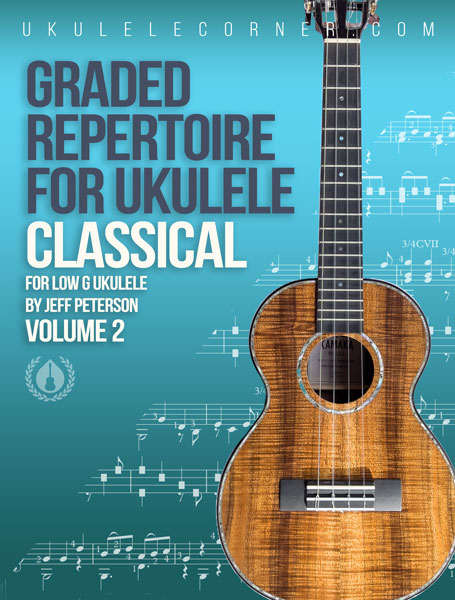
Graded Repertoire for Classical Ukulele: Volume 2
La Paloma comes from our book Graded Repertoire for Classical Ukulele: Volume 2. The book has around 50 pieces of classical masterpieces carefully arranged for low-G ukulele in a progressive order. Starting with simple famous melodies like Bach’s Minuet in C, you progress step-by-step all the way through to classical favorites such as Fauré’s Pavane and Leyenda by Issac Albéniz.
Pick up your copy of Graded Repertoire for Classical Ukulele: Volume 2 here




Just wonderful Jeff- suddenly La Paloma appears more accessible with your excellent up close video so we can see how it is played, a delightful arrangement