
Lesson
Performance
Clair de Lune by Debussy on Low-G Classical Ukulele
Introduction
In this article we’ll look closely at Clair de Lune by Debussy on low-G classical ukulele in the key of F.
Clair de Lune is the third movement of Debussy’s Suite Bergamasque, and it has become one of the most recognizable pieces in classical music. It’s been heard everywhere and arranged for many instruments, and its ubiquity is perhaps why it translates so naturally to the ukulele.
The title “Clair de Lune” means “moonlight,” and it points back to Paul Verlaine’s poem of the same name. That poem draws on the Watteau-style fête galante world of masked figures and dancing bergamasques, and the piece carries that atmosphere in its sound.
As you work through this arrangement, keep the overall goal simple. Let the rhythm feel natural, separate melody from accompaniment, and aim for a flowing arpeggio texture that supports the line rather than competing with it.
Rhythms
Treat 9/8 as three big beats in a bar, with three smaller divisions inside each beat. You can count all nine eighth notes when you first learn a measure, but you’ll play more musically when you feel it as a calm group of three larger beats: 1, 2, 3.
Once that big pulse feels steady, keep the subdivisions moving underneath it. These subdivisions give the piece its gentle motion, even when the phrase itself feels unhurried.
Watch for spots where a “two” appears over a group of notes. Use that marking to switch your subdivision so you place two notes in the space where you normally feel three. However, a real challenge of these “duple” beats is that we still want the measure to carry that feel of three big beats.
A great way to do this is to practice switching from three to two beats. Let the divisions of two feel slightly relaxed rather than rushed. Set a metronome to a slow three-beat pulse and practice dividing a beat into three parts, then into two parts, so you can move between those feels without losing the meter.
Separating voices — melody and accompaniment
Use the notation to help you separate layers. When you see stems pointing up and down, treat the up-stem notes as the melody and the down-stem notes as accompaniment.
Bring the melody forward and keep the accompaniment lighter. You’re not trying to make every note equally important; you’re trying to make the listener hear a line carried by the top notes while the arpeggios create the wash underneath.
In the opening, notice that the melody does not always land where you expect. Bringing out the melody note on beat 3 will prevent you from forcing it onto the downbeat. Keep the accompaniment steady so the melodic entrance feels intentional.
As you play through longer passages, keep returning to the same idea of balance between melody and accompaniment. Let the arpeggio stay a little softer than the melody, and allow crescendos and decrescendos to shape the line without turning the accompaniment into the main event.
Right-hand challenges
Start by learning the opening right-hand arpeggio sequence as a single repeating gesture. Begin with thumb then index on the lowest two strings, place a higher note with your ring finger, then continue through the arpeggio so the motion feels continuous rather than like separate plucks.
In later sections, aim for the sensation of a smooth flow across the strings, moving through thumb, index, middle, and ring in a way that feels connected. That flowing feel matters as much as the exact order, because it keeps the texture from sounding segmented.
Left-hand challenges
Set up an F chord at the start and use your pinky for the high melody note. Treat that as your first reminder that the melody often lives on top while the harmony sits underneath.
In measure 5, your pinky needs to reach up to the 10th fret. Expand the hand without locking the pinky straight. Keep the finger curved, with an arch, so the reach stays controlled.
Pay attention to spots where the harmony shifts slightly and your chord shapes change in small ways. When a change feels awkward, block out the two chords without the picking pattern, then practice the shift between them until the left hand can get to those shapes comfortably.
For left-hand fingerings, choose fingerings that lets notes overlap when you need the high string to keep ringing. That may mean the pinky needs to hold down a note while other fingers move. But that will be an important component of the balance of voices we talked about earlier.
Practicing
When a section feels difficult, limit the scope. Work on just one or two measures at a time. Try not to take in large ideas at once, but just focus on small, digestible chunks.
But once you’ve done that work, it’s important to zoom back out and look at the larger picture. When you have a section of music that feels like a complete idea, treat it like one full phrase. Group three or four measures, such as measures 15–18, and work phrase by phrase in four-bar chunks. Then connect each of the phrases together to smooth out transitions between each one.
Working through the piece chunk by chunk and phrase by phrase like that will reward you with accuracy and deeper knowledge of the music at the end of the process.
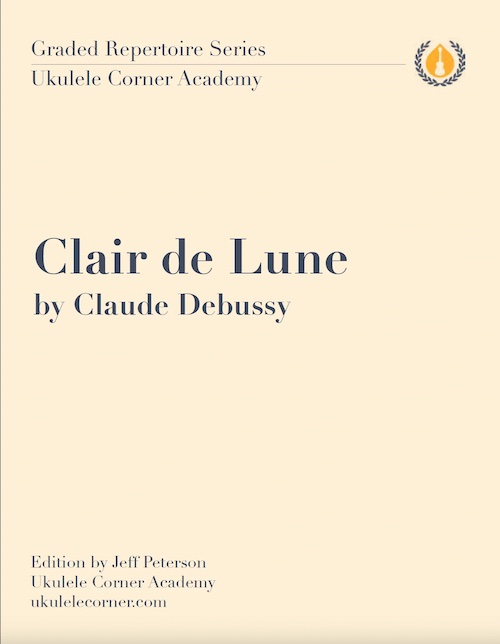
Clair de Lune by Debussy: Score + TAB
Go here to purchase your copy of Jeff’s arrangement of Clair de Lune by Debussy with score + TAB.
This is just one of Jeff’s many wonderful arrangements of classical masterpieces for ukulele. You can find scores with TAB along with full video lessons and performances of these arrangements at Ukulele Corner Academy. The Academy has a comprehensive curriculum to guide your progress learning ukulele. We will take you beyond just strumming chords or accompanying singers to learning solo fingerstyle songs and wonderful arrangements like Clair de Lune.

Nice playing Jeff. Where are the arrangement tabs for this piece??
Very well done. Are arrangement tabs available?
Aloha Richard, the sheet music is available here: https://cgcpublishing.com/collections/ukulele/products/claire-de-lune-for-low-g-ukulele-pdf-download
Aloha Pat, you can find the music here: https://cgcpublishing.com/collections/ukulele/products/claire-de-lune-for-low-g-ukulele-pdf-download
I absolutely love to hear you play on the ukulele. Hearing you play has made me desire to learn classical music on the ukulele, I can respectively say, you are my inspiration to classical music on the ukulele. I just bought another ukulele with the low G . It’s a Epiphone Les Paul acoustic/ electric Concert ukulele. I love it. Now I have both!!! says Judy Corrette
That was absolutely amazing 😱