
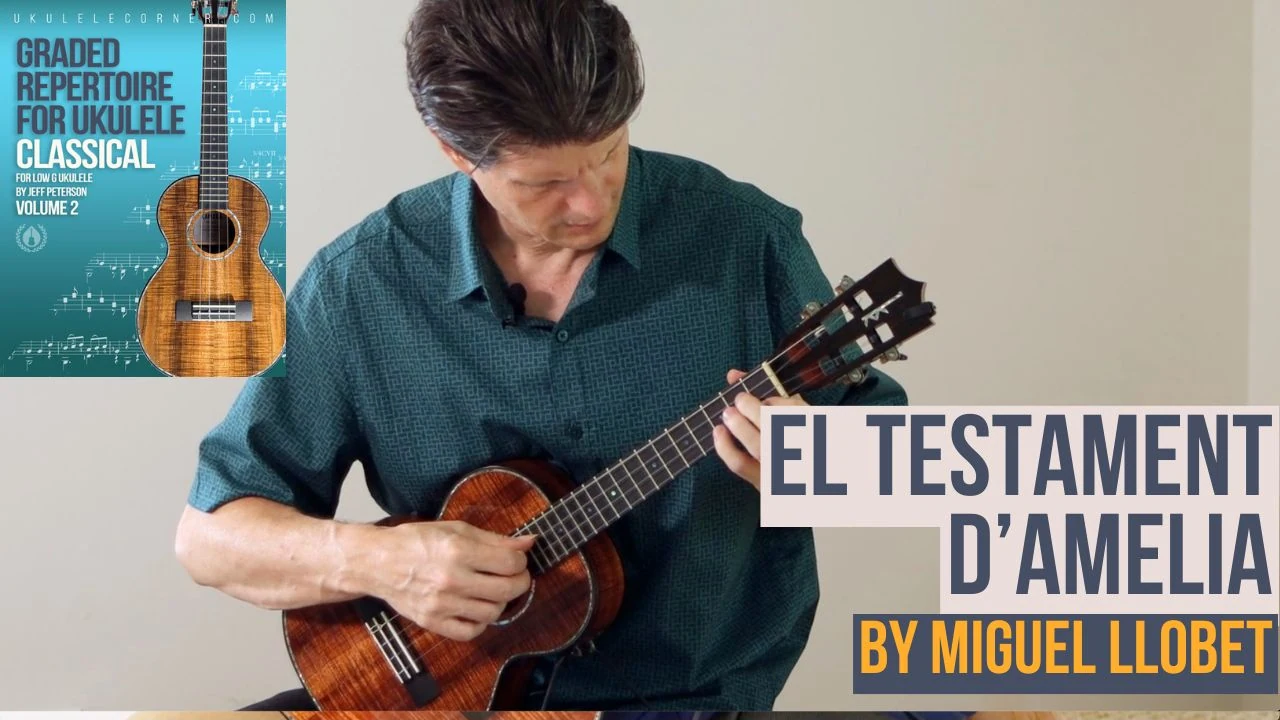
El Testament d’Amelia for Classical Ukulele: Background and Performance Notes
El Testament d’Amelia is one of the best-known Catalan folk melodies to enter the classical plucked-string repertoire. Many players first encounter it through Miguel Llobet’s guitar setting, where a simple song is transformed into a compact study in balance, tone, legato, and color. In Jeff’s arrangement for low-G ukulele, those same musical concerns remain central. The piece asks you to project a singing line clearly while managing close-position chords, shifts, slides, and harmonics with control. For that reason, it works well both as a performance piece and as a technical study.
Background: the folk song, Llobet’s guitar setting, and the low-G ukulele arrangement
El Testament d’Amelia is a traditional Catalan song, usually associated with a tragic narrative ballad. Early twentieth-century song collections helped preserve it in print, and by 1900 Miguel Llobet had arranged it for solo guitar. That arrangement later became the opening piece of the group commonly known as the Catalan folk songs or Canciones Populares Catalanas.
Miguel Llobet
Llobet was a central figure in the early modern classical guitar tradition. Born in Barcelona in 1878, he studied with Francisco Tárrega and became known both as a touring virtuoso and as an arranger of Catalan songs for solo guitar. Those arrangements helped bring regional song material into the concert repertoire without treating it as raw folklore alone; instead, Llobet recast the melodies in a refined instrumental language shaped by idiomatic voicing, resonance, and color.
The Testament
El Testament d’Amelia is especially effective in that respect because the tune itself is direct and memorable, while the accompaniment can be harmonized in ways that deepen the atmosphere without obscuring the melody. Llobet’s version became one of the most widely played of the Catalan arrangements, and it remains a standard item in the classical guitar repertory.
The lyrics and the tragic story of the song
The song is a narrative ballad, and its text is much darker than the gentle surface of the melody may first suggest. Sources describing the song consistently identify it as a tragic tale in which Amelia, the king’s daughter, lies dying after being poisoned by her mother or stepmother. In the central dramatic exchange, the mother asks what illness troubles her, and Amelia answers that her mother already knows the cause: she has given her poison.
One of the recurring lines of the song is:
“Ai, que el meu cor se’m nua / Com un pom de clavells!”
This refrain describes Amelia’s heart tightening or knotting “like a bouquet of carnations,” an image that reinforces both physical suffering and emotional distress.
As the ballad continues, Amelia prepares for death and speaks in the manner of a final testament. In some versions of the story, the poisoning is connected to jealousy and betrayal within the household. That background helps explain why the song carries such a strong sense of restrained grief. It’s not just sad; it’s a ballad of accusation, family conflict, and approaching death.
Knowing that story can affect performance in useful ways. The piece does not need exaggerated rubato or sentimental treatment, but it does benefit from a serious, vocal approach. The melody should sound like a sung lament, while the accompaniment remains secondary and supportive. The tragic narrative also makes sense of the harmonics in the arrangement: they can be heard not just as technical color, but as a change in sonority that momentarily alters the emotional distance of the song.
Bringing El Testament d’Amelia to Ukulele
Jeff’s low-G ukulele arrangement transfers that musical design to an instrument with a different scale length, tuning system, and sustain profile. That matters. On low-G ukulele, the bass register is available in a way that supports the darker character of the piece, especially in G minor, but the player must be deliberate about sustaining the melodic line. The arrangement therefore makes practical use of finger substitutions, slides, and carefully placed harmonics so that the piece remains singable rather than fragmented. In that sense, the ukulele version is not just a reduction of the guitar original. It is an adaptation that preserves the essential texture of melody plus accompaniment while solving it in ways that suit the low-G instrument.
Performance notes for learning the piece
This is a slow waltz in G minor. The tempo leaves space for expressive phrasing, but it also exposes every break in legato and every imbalance between melody and accompaniment. Since the notation gives the melody with upward stems and the accompaniment with downward stems, begin by practicing the melody in isolation. First, identify the melodic line by locating all the up-stems, then practice playing that line by itself. Once that line is secure, add the accompaniment without letting it compete for attention.
The opening measures establish the main technical pattern of the piece. In measure 1, replace the third finger with the first finger on beat 3 so that the following chord and slide are prepared in advance. This kind of left-hand planning helps you prepare for what’s next in advance. The note itself is not the problem; the transition that follows is the problem. A well-timed substitution solves that transition before it arrives.
The slides or glissandi in measures 2 and 5 need similar planning. In measure 2, use the fourth finger to slide from the third to the fifth fret. In measure 5, do the same kind of motion with the third finger. Do not treat these slides as decorative add-ons. They are part of the legato structure of the melody. Practice them slowly enough that you can hear a connected line from the first pitch to the destination pitch, with no accent caused by excess finger pressure and no gap caused by releasing too early.
Harmonics
The harmonics are another defining feature of the arrangement. In measure 7 on beat 3 and measure 8 on beat 1, the natural harmonics are produced by placing the fourth finger of the left hand lightly over the fret wire (we call this the “node”). Accuracy of placement matters more than pressure. If the touch is too heavy, you’ll get a dud note; if the finger is too far from the fret node, you won’t get much pitch at all. Practice moving to these nodes without rushing, and listen for a clean, bell-like tone rather than a percussive effect.
The artificial harmonic on beat 3 of measure 8 requires a more deliberate setup. Hold the second fret of the fourth string with the left hand. Then place the right-hand index finger twelve frets above that fretted note and pluck with the thumb. From measure 17 through measure 24, use the same basic harmonic technique, but pluck with the ring finger instead. In measure 17, the middle finger also plays the G on the second string. The main challenge here is coordination, not speed. Set the hand position first, confirm the contact point of the touching finger, and only then pluck. Artificial harmonics often fail because the player tries to execute them as a single quick gesture rather than as a prepared mechanism.
From measure 17 onward, the harmonic writing should not interrupt the musical line. Even though the sonority changes, the phrase still has direction. Avoid treating those measures as a technical display. They function musically as a change of color within the same song.
Bass melody
From measure 25 to the end, the melody shifts into the bass. Bring out the lower voice while keeping the upper chords light. Practice this section by isolating the bass melody first, then reintroducing the upper notes at a much softer dynamic. If the chords are too heavy, the phrase loses shape and the melody can get lost in the mix.
Across the whole piece, the most useful practice strategy is to connect technical decisions to musical priorities. Finger substitutions serve legato. Slides serve continuity of line. Harmonics serve color and contrast. Dynamic balance serves clarity of texture. If you organize your work that way, the technical details stop feeling miscellaneous and start to serve the music.
Conclusion
El Testament d’Amelia occupies an important place in the plucked-string repertory because it links folk material, concert arrangement, and instrumental technique in a very concentrated form. The traditional melody gave Llobet strong material to work with, and his guitar setting remains the model through which many players know the piece. Jeff’s low-G ukulele arrangement carries that tradition into a different instrumental context while keeping the same core demands: a singing melody, controlled accompaniment, and colorful techniques. For classical ukulele players, that combination makes the piece historically interesting and technically worthwhile.
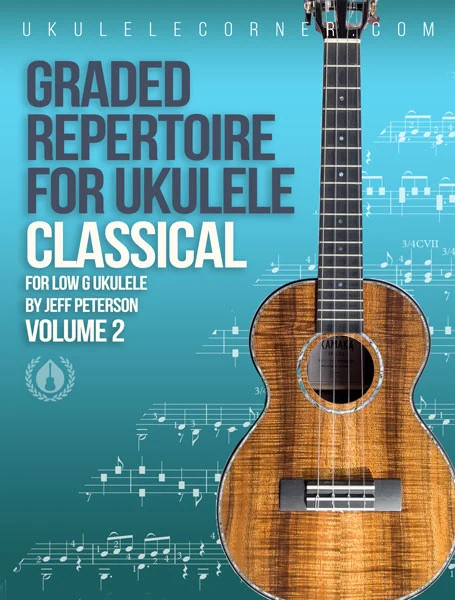
Graded Repertoire for Classical Ukulele: Volume 2
El Testament d’Amelia comes from our book Graded Repertoire for Classical Ukulele: Volume 2. The book has around 50 pieces of classical masterpieces carefully arranged for low-G ukulele in a progressive order. Starting with simple famous melodies like Bach’s Minuet in C, you progress step-by-step all the way through to classical favorites such as Fauré’s Pavane and Leyenda by Issac Albéniz.
Pick up your copy of Graded Repertoire for Classical Ukulele: Volume 2 here.

That was lovely. If I ever make it through that grade 1 book, I’ll attempt it someday.
This piece is so beautiful yet sad. Thank you for sharing.