
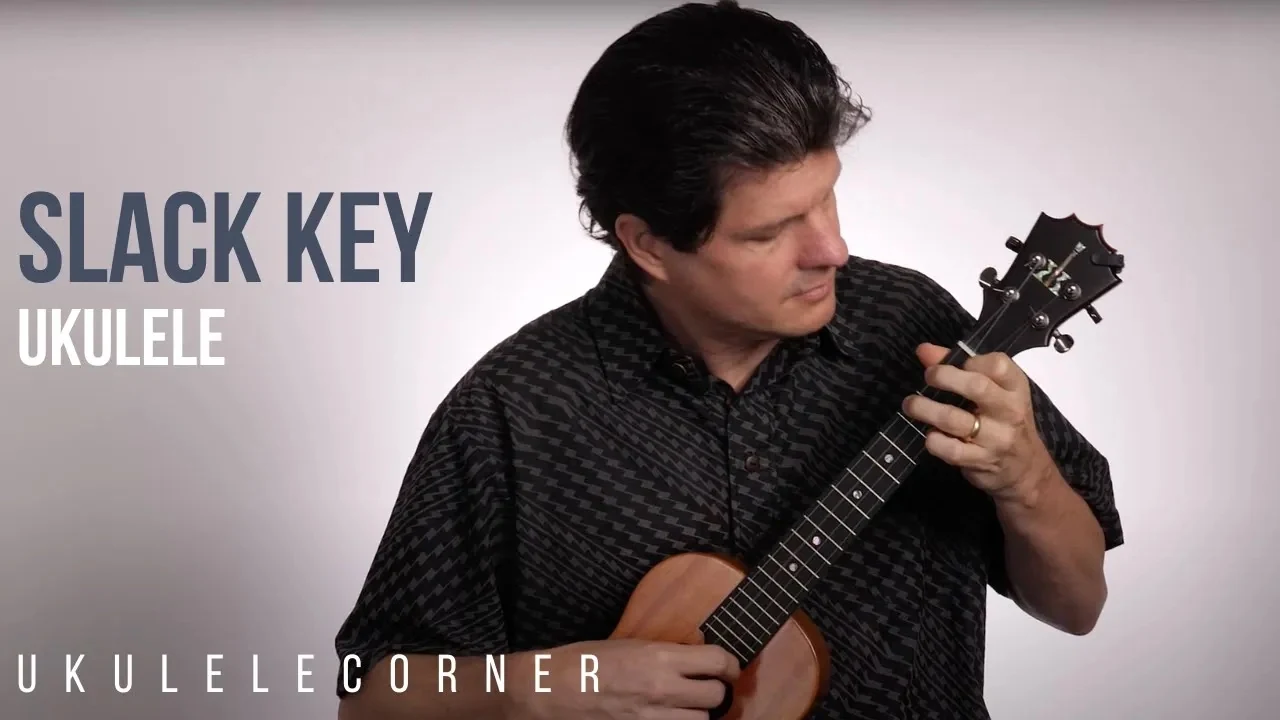
Slack Key Ukulele
The term “slack key ukulele” may be new to you. Usually we use slack key to talk about guitar. And it simply refers to the slackening of the guitar’s strings, or its tuning. Slack key guitar offers different tunings to create new colors, different sounds, and to make it easier to play with others. But slack key ukulele? That’s not as common.
Nonetheless, you can bring the inspiration of slack-key guitar to the ukulele. There are many new tunings that work well. Check out the improvisation in the video above, for instance. Here Jeff uses a GCEG tuning on a tenor ukulele. You may notice that Jeff uses a lot of open strings to create beautiful overlapping harmonies and sounds. That’s one thing these open tunings can open up to you. But what else is possible?
New Ukulele Tunings?
In this great interview with Ukulele Magazine, Jeff talks about the different slack key tunings he uses for ukulele:
How has your guitar playing affected or informed your ukulele playing and teaching?
Having a background playing different styles of music on the guitar has helped me develop arrangements and learning resources for the ukulele that are based on my experience playing slack key, rock, jazz, and classical music.
I have been fortunate to study with many great teachers and have found that so much of what I have learned on the guitar applies beautifully to the ukulele. I have also been able to arrange of lot of my slack key guitar compositions for the ukulele using the GCEA tuning and many variations of slack key tunings, including GCEG, GCDB, FCFA, GCEbG, and ACDA—all variations on the low-G tuning. I have been able to apply concepts of theory from the classical and jazz traditions along with various techniques from guitar playing that can be used together with traditional techniques of strumming and fingerstyle playing on the ukulele. I have also been able to draw on music from the classical repertoire for ukulele arrangements.
What is really quite amazing is how fluent Jeff is at moving in and out of these different tunings. For you guitarists out there, if you’ve ever played in Drop D, or DADGAD, you know how difficult it can be to think on the fly about what notes belong where. It really takes time to adjust for a lot of people.
But now imagine seamlessly moving from one to another and another AND another tuning. It’s like magic. But this is exactly what Jeff is able to do. In the hands of someone like Jeff you can really start to see that slack key is like a multilinguist who is fluent in many different languages. And it’s remarkable to behold.
Getting Started: The Open C Tuning
Of all the slack key tunings Jeff uses, the one most players start with is open C: G, C, E, G. It’s a great entry point into the style: retune one string, and the ukulele rings with its own harmony before you’ve fretted a single note.
Setting Up the Open C Tuning
To get there from standard low-G tuning, you only need to retune one string:
- Leave the G, C, and E strings as they are.
- Lower the top (A) string down a whole step until it matches G. You can check the pitch against the third fret of the C string, which also rings G.
Strum the open strings once you’re retuned, and you should hear a clean, open C chord. That’s your reference point that the tuning is set correctly.
Why This Tuning Suits the Keys of C and F
Because the open strings already form a C chord, playing in the key of C becomes noticeably easier in this tuning, since many of the chords you need sit right there under open or lightly fretted positions. The key of F is a close second, since its I, IV, and V chords (F, B♭, and C7) also fall into comfortable shapes. Other keys are still playable, but C and F are where slack key ukulele really shows off what the open tuning can do.
The Basic Chords: C, F, and G7 in Open C Tuning
A handful of chords cover a lot of ground in this tuning:
- C (open): all four strings open.
- C (fuller voicing): fret the fifth fret on the top string only, leaving the rest open.
- F: second fret on the C string, first fret on the E string, second fret on the top G string, with the low G string open.
- G7: second fret on the C string, first fret on the E string, with the top string either open (a simpler G7) or fretted at the fourth fret (a richer G9-flavored voicing that’s very common in this style).
Together, C, F, and G7 are enough to play through a huge amount of traditional Hawaiian repertoire once you’re comfortable with the shapes.
What Makes Slack Key Feel Different: Melody Inside the Chords
The technical side of the tuning is only half the story. What really defines the ki hoʻalu sound is how those chords get used. Rather than holding a chord shape and strumming it statically, players weave small melodic movements in and out of the chord: sliding a finger up to turn a G7 into a G9 and back, for example, or letting an open string ring underneath a moving line. It’s this constant, subtle motion inside otherwise simple chords, heard clearly in a typical vamp resolving from G7 to C, that gives the style its flowing, conversational quality.
Playing in the Key of F: F, B♭, and C7
Once F feels comfortable, the natural next step is its I–IV–V family: F, B♭, and C7.
- B♭ normally requires a barre chord in standard tuning, but in open C, you can play it without one, a genuine advantage of the tuning.
- C7 has a couple of nice variations, including an octave voicing using the third fret on both outer G strings, which resolves especially well back to F.
Running through F–B♭–F–C7 (a I–IV–I–V progression) is a great way to get these shapes under your fingers, and the same progression works in C using C–F–C–G7.
Hearing It in the Repertoire
This tuning and style show up throughout the traditional Hawaiian songbook. Pieces like “Pua Hone” and “Waimanalo Blues” are good examples of how these chord shapes and that melodic, moving quality come together in real music, rather than staying abstract exercises.
How to Start Practicing Ki Hoʻalu on Ukulele
The fastest way in is to lean on songs you already half-know. Take a few accompaniment pieces you’ve already learned in standard tuning, retune to open C, and work through them again: first just strumming through the chord changes, then experimenting with picking out small melodic movements within them. It’s also a good excuse to bring in the Hawaiian double strum and give your accompaniment that same island feel. Between the open C and F chord families and a little patience with the new shapes, most players find the sound clicks into place surprisingly quickly.
If this style speaks to you, it pairs naturally with the rest of our Hawaiian ukulele lessons.
***
So we hope you enjoy this introduction to slack key ukulele! At Ukulele Corner Academy you can study with Jeff and learn many different styles of ukulele, including classical, Hawaiian, pop, jazz, and blues. Join Ukulele Corner Academy today!

In your second comment under SETTING UP THE OPEN C TUNING you say to check the pitch by fretting the 3rd fret of the C string. Should that be the 3rd fret of the E sting or 7th fret of the C instead?
Yes–that is correct the G note is on the 3rd fret of the 2nd string or E string.
Mahalo!
Jeff