

Alman by Robert Johnson for Classical Ukulele
Introduction
Alman by Robert Johnson is a Renaissance-era piece originally written for lute and arranged here for low-G ukulele. Johnson was an English Renaissance musician, not to be confused with the blues guitarist of the same name. This piece is based on a German dance form and is played here in D minor.
The arrangement uses 4/4 time and begins with a pickup on beat 4. Much of the piece depends on rhythmic clarity and the overlap between bass and melody. The notes often move across different strings so they can sustain into one another, creating a fuller sound than you would get from a single-line melody.
As you work through the piece, pay close attention to the fingerings. Many of them are there to help one part keep ringing while the other part moves.
The Opening and the Dotted Rhythm
The opening outlines D minor and immediately introduces one of the main rhythmic ideas of the piece: a dotted eighth note followed by a sixteenth note. This rhythm gives the first section its character, so it is worth isolating before trying to play the full texture.
Count the rhythm in sixteenth-note subdivisions. The dotted eighth takes up the first three subdivisions of the beat, and the sixteenth note comes on the fourth. In other words, feel the beat as four small parts. The longer note fills the first three, and the short note completes the beat.
One helpful way to practice this rhythm is to play it on an F scale. First, play the scale with the dotted rhythm. Then play the same notes as even eighth notes. This will help you hear the difference clearly. The first version has a lifted, pointed feel. The second version is smoother and more even.
The first phrase uses this dotted rhythm as part of a sequence. It begins by outlining D minor, then moves through F and continues up the fingerboard. The sequence later includes a three-string barre at the 5th fret and a walk up to the 8th fret. Keep the rhythm steady as the left hand changes position.
Right-Hand Alternation
Use right-hand alternation to keep the line moving. Alternate index and middle on the upper string while using the thumb for notes on the 4th string. In the opening, the thumb plays the F and E on the 4th string while the fingers continue above it.
This division helps the parts stay organized. The thumb handles the lower voice, while the fingers handle the upper line. You can also use index and middle in some places where the thumb is suggested, but make sure the result still feels smooth and controlled.
The goal is not simply to assign a finger to each note. The right hand needs to support the rhythm. If the dotted rhythm becomes uneven, slow down and return to the subdivision.
Chord Shapes and Sustain in the First Half
After the first line introduces the main material, begin building in the chord shapes. The music outlines F and D minor, then moves through shapes that need careful left-hand planning.
Several passages work best when you leave fingers down in one voice while the other voice moves. This allows the notes to ring over one another. When the third finger can stay in place, keep it down until the music requires a change. These small moments of sustain help the arrangement sound more connected.
Later in the first half, the hand moves through G minor, C, and B-flat shapes before returning toward A and D. At measure 9, the D on the 2nd fret of the 3rd string needs to come through clearly. Stop the 4th string with the thumb so that lower string does not muddy up the sound here.
After measure 9, the next phrase begins with a soft pickup. This phrase uses much of the same chord material, but the rhythm changes. The dotted figure smooths out into more even eighth notes. Once you know the first line well, the later phrase will feel familiar because the shapes return in a different rhythmic setting.
The Second Half and Campanella Playing
The second half introduces more motion across the strings. The arrangement uses campanella playing, where notes are placed on different strings so they can ring together. This is especially useful on the ukulele because it allows the sound to sustain more naturally.
The second half begins from an A chord after the D minor shape. The open E on the 2nd string helps the hand move, and other open strings create similar opportunities later. The open strings also allow one sound to continue while the hand prepares the next shape.
The music then moves through a sequence of related shapes. Some of the fingerings may feel unusual at first, but they make the overlapping voices possible. Follow them carefully before looking for alternatives.
Left-Hand Guide Fingers
In the second half, guide fingers become especially important. Around measure 18, certain fingers stay close to the strings and help the hand find the next shape. Work through this section very slowly and notice which fingers can remain in contact with the fingerboard.
Measure 22 needs close attention. The passage uses the 3rd finger, 2nd finger, and pinky, followed by a move where the 2nd finger comes down to the 2nd fret of the 4th string. Soon after, a short run moves 5, 3, 1, followed by the open A on the high string on beat 3.
The same note then appears on a different string because it belongs to a different voice. Let it sound slightly different. Allow it to overlap with the surrounding notes so the listener can hear the change in voice, not just a repeated pitch.
Use the 3rd finger where indicated, especially when doing so frees the 2nd finger for the next note. These choices are practical, but they also support the musical texture.
Letting the Voices Overlap
When the second half repeats, the chord shapes remain mostly the same, but the rhythm changes again. Instead of block chords, the music moves in steady eighth notes. Keep the same fingerings so the voices can continue to overlap.
Measure 26 is a good place to focus on this. The eighth notes should ring as much as possible. Hold fingers down for as long as the music allows, and release only when the next movement requires it.
There is a shift at the end of measure 28 where you cannot keep everything ringing. Outside of that kind of necessary move, aim for as much overlap as you can. The more carefully you sustain the notes, the more clearly the two-part writing comes through.
The Ending
At the end of the piece, play the second-to-last note, the A, then stop the 4th string with the thumb as you arrive on the final D. This keeps the ending clear and allows the last note to ring.
The final measure has three beats because the piece begins with a pickup. Since the opening pickup is one quarter note, the last measure leaves out that amount of time.
Conclusion
Alman works well on low-G ukulele because the arrangement allows the bass and melody to connect across the strings. The main work is in the rhythm and the sustain. Keep the dotted rhythm precise in the first section, then let the later eighth-note passages ring wherever the fingering allows.
Move slowly through the second half and trust the fingerings. They help the voices overlap, which is where much of the character of the arrangement comes from.
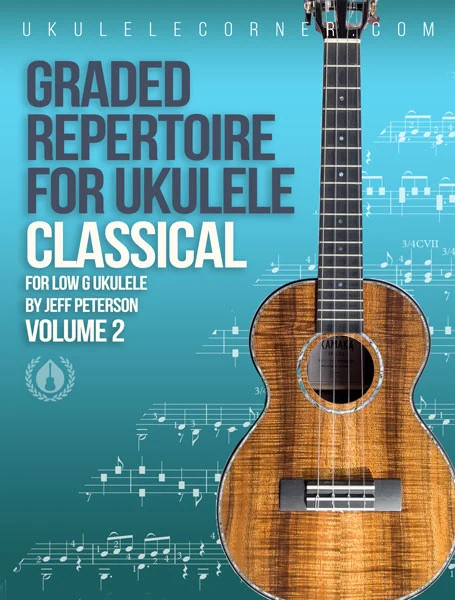
Graded Repertoire for Classical Ukulele: Volume 2
Alman by Johnson comes from our book Graded Repertoire for Classical Ukulele: Volume 2. The book has around 50 pieces of classical masterpieces carefully arranged for low-G ukulele in a progressive order. Starting with simple famous melodies like Bach’s Minuet in C, you progress step-by-step all the way through to classical favorites such as Fauré’s Pavane and Leyenda by Issac Albéniz.
Pick up your copy of Graded Repertoire for Classical Ukulele: Volume 2 here