

Eine Kleine Nachtmusik for Classical Ukulele—Performance & Lesson
Introduction
Wolfgang Amadeus Mozart’s serenade Eine kleine Nachtmusik, K. 525, is one of the most famous works in the classical repertoire. The title simply means “a little night music.” Mozart completed the piece in Vienna on 10 August 1787, during a time of personal and financial difficulty. He had been forced to move his family to a cheaper apartment and was still reeling from the death of his father Leopold earlier that year. Despite the hardships, the music radiates light and joy. Perhaps it reminds us that beauty often appears during the darkest moments of life. In this blog we explore the history of the piece, its four‑movement structure and Jeff Peterson’s arrangement for classical ukulele. Performance tips and lesson notes will help you bring this beloved melody to life on your instrument.
Mozart and his Serenade
Mozart was born in Salzburg in 1756 and exhibited prodigious talent from a young age. By his teens he had composed concertos and symphonies and performed before European royalty. Feeling constrained at court, he relocated to Vienna in 1781, where public concerts and amateur music making created new demand for his work. Eine kleine Nachtmusik (“Serenade No. 13 for strings in G major”) was probably written for an outdoor ensemble of two violins, viola, cello and double bass, though it is now often played by a full string orchestra. Mozart’s entry in his catalogue lists five movements, but only four survive; the second movement (a minuet and trio) has been lost. Today we know the piece through four contrasting movements:
-
Allegro: a bright opening with the famous ascending theme in sonata‑allegro form; key of G major.
-
Romance–Andante: a lyrical rondo with repeating themes (A–B–A–C–A); key of C major.
-
Menuetto–Allegretto: a stylish minuet and trio that begins on the upbeat; minuet in G major with a trio in D major.
-
Rondo–Allegro: a lively finale with two rondo themes and a sonata‑rondo structure; key of G major.
Because the serenade was completed so close to the end of Mozart’s life, it has been embraced as a late‑period gem. The first movement’s unison opening, nicknamed the Mannheim rocket, launches listeners into a joyful sequence of themes before returning home to G major. The Andante second movement provides contrast with its graceful rondo structure and shifting between major and minor. The minuet begins on the upbeat and leads to a trio in the dominant key before returning to the opening dance. Finally, the Rondo finale keeps momentum with two alternating themes and finishes with a brief coda .
Arranging Eine kleine Nachtmusik for Ukulele
Jeff Peterson’s arrangement brings Mozart’s serenade to the low‑G ukulele. The piece is transposed to F major so that the main theme sits comfortably under the fingers. The arrangement draws on techniques familiar to classical guitar and Hawaiian slack‑key playing, such as Alberti‑bass patterns, block chords, slurs, and arpeggios. Below you’ll find a summary of the key techniques highlighted in Jeff’s lesson video.
Starting with the main theme
The lesson begins with the famous F‑major theme. Jeff suggests fingering the opening as an F shape on the left hand and using thumb and middle finger in the right hand to pluck the bass and melody strings. Count “1-and, 2-and, 3-and, 4-and” to keep the rhythm steady. When crossing strings, alternate the index and middle fingers so that the index plays the higher string. After the opening phrase, form a four‑note F chord with a C on top and pluck it as a block chord, again using thumb, index, and middle fingers for clarity.
Alberti‑bass section
From measure 5 the piece moves into an Alberti‑bass texture: an alternating bass pattern common in classical and folk music. Keep steady eighth notes while alternating between two‑note chords and single notes. Jeff recommends shifting to a C7 shape by adding a B♭ on the second string and maintaining the alternating pattern. Practice this four‑bar phrase separately until it flows easily. Focus on alternating the right‑hand fingers so that the index plays the higher string.
Slurs, hammer‑ons and pull‑offs
Measures 9–11 introduce more motion over the F chord with pull‑offs, hammer‑ons and quick shifts up to the fifth fret. Jeff emphasizes practicing these slurred phrases very slowly: start at a tempo where each hammer‑on and pull‑off is clean and rhythmically even before gradually speeding up. Shorten the first chord slightly to articulate the passage and keep your right hand fluid so that sixteenth‑note slurs sound smooth. Using the pinky (fourth finger) on the left hand allows your first finger to remain free for upcoming notes.
Chord voicings and finger independence
Later in the arrangement (measure 11 onward), you’ll encounter third‑interval harmonies such as 5–3 and 6–5 fingerings. When playing a C chord, use the fourth finger for the top note so the first finger can immediately drop to the second string when needed. In measure 21, Jeff suggests repeating a beautiful F‑major arpeggio twice and then leaping to a higher F chord (5–5–8) on beat 3 before returning to the low F chord. Practice jumping between these shapes while keeping the right‑hand pattern consistent.
Practice tips
-
Work phrase by phrase. Break the arrangement into four‑bar sections and master each section before linking them together. Isolating tricky passages prevents overwhelm and builds confidence.
-
Focus on the right hand. Many challenges come from the picking hand. Alternate index and middle fingers when crossing strings and reserve the thumb for bass notes. When playing arpeggios, try a middle–index–middle pattern while keeping the thumb on the third string.
-
Plan your left‑hand fingering. Use fingerings that prepare you for what comes next. For example, using fingers 2 and 4 on chords frees finger 1 to play an upcoming bass note. Thinking ahead will help the music flow seamlessly.
-
Listen for dynamics. Incorporate the dynamics noted in the performance: play the first four measures forte, drop to piano at measure 5, build a crescendo at measure 9 and accentuate the contrast between legato chords and staccato counter‑phrases in measures 11–17. Finish with a gentle decrescendo on the final two chords.
Contextual Listening
Appreciating Eine kleine Nachtmusik on ukulele becomes richer when you understand its orchestral origins. In the string serenade, violins carry the brilliant melody, while the viola, cello, and bass provide a dancing accompaniment. The Allegro movement is in sonata form with two main themes and a development that briefly visits minor keys. The Romance movement is a rondo (A‑B‑A‑C‑A) whose recurring melody alternates with contrasting episodes and touches on C minor. The Menuetto movement uses the minuet‑and‑trio form and begins on the upbeat. The finale employs sonata‑rondo form with repeated themes and an exuberant coda. Listening to orchestral recordings will give you a sense of phrasing, dynamics, and interplay that you can translate to the ukulele.
Conclusion
Mozart wrote Eine kleine Nachtmusik during a turbulent period of his life, yet the music sparkles with optimism. The serenade remains a staple of classical concerts and popular culture. Jeff Peterson’s ukulele arrangement allows you to explore this masterpiece on our modest four‑string instrument. By studying the dynamics, employing Alberti‑bass textures, and mastering slurs and arpeggios, you can capture the spirit of Mozart’s night music. Take your time, practice deliberately, and enjoy bringing this classic to your ukulele repertoire.
For further reading
-
“Eine Kleine Nachtmusik.” Wikipedia. Last modified November 15, 2025. Accessed February 7, 2026. https://en.wikipedia.org/wiki/Eine_kleine_Nachtmusik.
-
Music Workshop. “Eine Kleine Nachtmusik: Background and Movements.” Music Workshop. Accessed February 7, 2026.
-
Classic FM. “The Surprising Story Behind Mozart’s Eine Kleine Nachtmusik.” Accessed February 7, 2026.
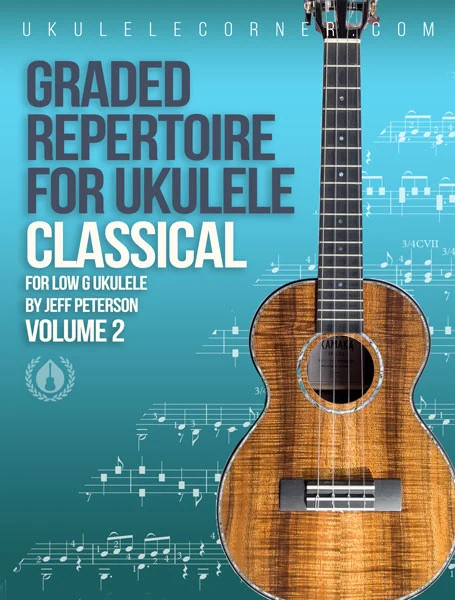
Graded Repertoire for Classical Ukulele: Volume 2
Eine Kleine Nachtmusik by Mozart comes from our book Graded Repertoire for Classical Ukulele: Volume 2. The book has around 50 pieces of classical masterpieces carefully arranged for low-G ukulele in a progressive order. Starting with simple famous melodies like Bach’s Minuet in C, you progress step-by-step all the way through to classical favorites such as Fauré’s Pavane and Leyenda by Issac Albéniz.
Pick up your copy of Graded Repertoire for Classical Ukulele: Volume 2 here.